Lucky Dog: How Being a Veterinarian Saved My Life by Sarah Boston

FOR IMMEDIATE RELEASE:
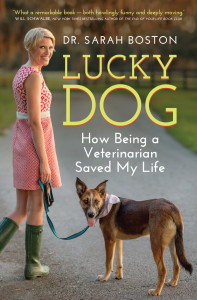
Lucky Dog Jacket

When veterinarian Sarah Boston was repeatedly told by doctors that the mass in her neck was probably nothing, she was skeptical. As a veterinary cancer surgeon, she knew that this was most likely thyroid cancer. She was right. In LUCKY DOG: How Being A Veterinarian Saved My Life, Sarah chronicles her journey through our slow-moving health care system providing us with an insightful memoir about how we can be better advocates for our own health care and what we can learn from the way we medically treat our pets.

With a keen eye for detail, a wry sense of humor and tough observations, Sarah questions the status quo of our healthcare system, noting the lack of individualized, compassionate care, while highlighting the similarities and differences in human and veterinary medicine and why, sometimes, being treated like a dog sounds pretty good. This “…remarkable book—both howlingly funny and deeply moving” (Will Schwalbe, New York Times bestselling author of The End of Your Life Book Club) is a unique, humorous, and educational journey that teaches us to trust our instincts, be our own advocates, and laugh while we’re doing it.

About the Author
Dr. Sarah Boston is an associate professor of surgical oncology, department of small animal clinical sciences, at the University of Florida. From age six, Boston knew she wanted to become a veterinarian. She has practiced veterinary medicine in various parts of Canada (including Guelph, Saskatoon, Vancouver, Calgary and Edmonton), the U.S, and New Zealand. She is currently President of the Veterinary Society of Surgical Oncology. She lives in Gainesville, Florida, with her husband, who is a large animal veterinarian, and their dog Rumble and cat Romeow. LUCKY DOG is her first book.

Dangerous Rhythm: Why Movie Musicals Matter by Richard Barrios

9780199973842FOR IMMEDIATE RELEASE:

Just as America went to war in Iraq, Rob Marshall’s Chicago razzle-dazzled audiences and took home six Academy Awards, including Best Picture. The last time a musical had won the top prize was 1969, when Oliver! won while the Vietnam War waged on. It’s no surprise that musicals serve as an escape, and they’ve been an important part of American culture since the first true musical film, The Broadway Melody, premiered 85 years ago in 1929.

In DANGEROUS RHYTHM: Why Movie Musicals Matter, Richard Barrios deconstructs the American film musical to understand how they entrance an entire country or how they flop. Film musicals are difficult to do right, and Barrios finds that an adaptation’s relationship to musical film history can make or break the adaptation. Throughout the entire span of both the musical, history keeps repeating itself even when the creators aren’t aware of it, with the films and performers of 1930 finding easy equivalents in those many decades later.

Musicals constantly go in and out of fashion, mixing skill with ineptitude and failure with success in proportions unknown elsewhere. DANGEROUS RHYTHM lays out the whole story in all its quirky richness: artists and masterpieces and disasters, times of glory and moratorium, decades of depression and war, and influences of society, television and the internet.

At once history, analysis, investigation and meditation, DANGEROUS RHYTHM both celebrates the art and laments the garbage in American film musicals, demonstrating how and why they are an important part of American culture.

About the Author
Richard Barrios worked in the music and film industries before turning to film history with the award-winning A Song in the Dark. He lectures extensively and appears frequently on television and in film and DVD documentaries. Born in the swamps of south Louisiana and a longtime resident of New York City, he now makes his home in western New Jersey, near Philadelphia.

The Olive Odyssey by Julie Angus

OliveOdysseyCoverPGW

FOR IMMEDIATE RELEASE:

“A well-researched paean to the magical olive, a scrumptious romp through history, agronomy, DNA science, cuisine, business, medicine, religion, and politics.”
Mark Pendergrast, author of Uncommon Grounds: The History of Coffee and How It Transformed Our World

Like Odysseus in Homer’s classic, Julie Angus, her husband and baby set out by boat across the Mediterranean to discover the mystery, history, and culinary delights of the olive.   A molecular biologist and published author, Angus tells a fascinating story that dates back tens of thousands of years in her new book OLIVE ODYSSEY: Searching for the Secrets of the Fruit that Seduced the World (Greystone Books; May 2014; $25.95; Hardcover; ISBN: 978-1-55365-514-5; Dist. by PGW).

Angus was inspired to research and write OLIVE ODYSSEY by her Syrian forebears’ intimate relationship with the olive and her memories of the tastes and smells of home.  On a recent visit with her extended family in the Middle East, she was impressed with the feast set out before her “but one item stood above the rest, not for its complexity or the effort required to prepare it but for its simplicity and purity.  It was a food that I had eaten all my life but that had never evoked such a response….It was olive oil.”

In the book Angus shares some of the drama of a sea-faring adventure from chasing down a suitable boat to avoiding potentially deadly storms.  From town to town beginning in Spain, she describes her encounters with experts like local olive farmers; her searches for wild olive trees and how you can tell the difference between a cultivated species and the former; the different regional complexities of flavor in individual olive oils; the many uses for olive oil including medicinal ones; and the corruption that has historically plagued the oil industry from as early as the Middle Ages.

When they returned home, Angus was armed with video, photos, interview transcripts, and actual tree samples.  Her analysis provides evidence of where the original cultivated olive trees came from as well as how their existence can be traced back to the dawn of civilization.  In recent decades olive oil has received more attention in restaurants—where bowls of oil are presented for bread instead of butter; and in specialty stores—where different varieties of infused or imported oils can cost hundreds of dollars. But it is much more than a “condiment” and Angus trusts that it will live on for millennia to come.

ABOUT THE AUTHOR:
Julie Angus is the author of Rowboat in a Hurricane: My Amazing Journey Across a Changing Ocean.  She is a recipient of the National Geographic Adventurer of the Year Award and holds a master’s degree in molecular biology from the University of Victoria.  She lives in Victoria, British Columbia.

Jennifer Sky: Queen of the Tokyo Ballroom

tokyo_ballroom

As someone who was abused as a child model, I am calling for the creation of an action committee to define and enforce labor protects in the fashion industry. 54% of models begin working on or before the age of sixteen. Agencies start recruiting at age thirteen. Many of the pictures in your favorite fashion magazines are little girls dressed up to look like women. This past fall, New York State passed the Child Model Law, granting protections for minors working as models in the fashion industry. Protections such as school-night curfews and on-set hour limits, chaperones, tutors and mandatory financial trusts are now law. Endentured to their agencies, models often return home traumatized and with little to no compensation. With the global clothing and textiles industry now generating upward of 2.5 trillion dollars a year, fashion can afford to offer positive work environments for their models. Please join me in helping to improve the labor conditions for these young workers.


You can sign Jennifer Sky’s petition on Change.org to Stop the Abuse of Children in the Fashion Industry or visit her website at www.jennifersky.com for more information.

You can also watch her PSA on Upworthy.