The Next Happy by Tracey Cleantis

The Next Happy by Tracey Cleantis

FOR IMMEDIATE RELEASE:

“A bold, brave and incredibly relevant book.”
—Lee Woodruff, New York Times best-selling author of Perfectly Imperfect—A Life in Progress, with her husband, Bob Woodruff, and CBS “This Morning” contributor

We all have dreams that drive us, and our passion propels us toward them. For some, it’s playing in the NFL or hitting number one on the Billboard charts, while others dream of a successful marriage and to have children. We all imagine this life while sacrificing and sometimes suffering to make it a reality. But what do we do when the dream is actually holding us back or causing us pain? In today’s society, we are told to “Never, ever give up,” but what happens when it’s time to let it go? What do we do next?

THE NEXT HAPPY: Let Go of the Life You Planned and Find a New Way Forward (Hazelden; March 2015; $14.95; Original Trade Paperback) by Tracey Cleantis, a licensed psychotherapist, is the counterpoint to the adage, “Hang in there; it will happen if you just follow your dreams.” In THE NEXT HAPPY, Cleantis teaches us how to move onward when the life we planned does not come to fruition.

“Just as the day before, and for years before that, no one could have told me that my dream wasn’t going to come true; on that day, no one could tell me that it was.” After many unsuccessful attempts to get pregnant and over $100,000 later, Cleantis moved on with her life. She explains that when a dream dies, the grief process must begin. An individual will often experience sadness, anger, and shame during this time. A strong support system, and being able to look inward for the reasons why the dream didn’t happen, are just some of the tools needed for the healing process to take place so we can proceed in a new direction.

Perhaps just as important as letting go is recognizing the causes of holding on to the dream in the first place, as this can be unhealthy to the individual. “There was something in me that just wanted the literal interpretation and was a bit afraid of the why,” she says of her dream to have children. Holding onto a dream for too long not only impedes us from gravitating toward something that will make us happy but has physical, psychological, and financial costs as well.

THE NEXT HAPPY provides the guidance and support to explain:

  • Why giving up on a dream does not make us a quitter
  • The reasons we hold onto dreams and refuse to let them go
  • How to identify when to let go of a dream
  • The differences between acceptance and closure
  • How getting to the next happy works

With down-to-earth wisdom from Tracey Cleantis, who has worked with hundreds of patients who have dealt with the loss of a dream, THE NEXT HAPPY is the key to letting go of the life you may have wanted for yourself and finding a new path forward. A world of possibilities is waiting . . . Will you take the first step?

ABOUT THE AUTHOR
Tracey Cleantis holds a master’s degree in marriage and family counseling and has built a national reputation as an expert on healing losses through her popular blog, La Belette Rouge, Freudian Sips on PsychologyToday.com, and her writings for the Huffington Post. She also has had interviews and advice featured in articles in Psychologies Magazine, Redbook, and on Fox News Boston, among others. Check out more about Tracey at http://www.traceycleantis.com/

ABOUT HAZELDEN:
The Hazelden Betty Ford Foundation is a force of healing and hope for individuals, families and communities affected by addiction to alcohol and other drugs.  It is the nation’s largest nonprofit treatment provider, with a legacy that began in 1949 and includes the 1982 founding of the Betty Ford Center. With 15 sites in California, Minnesota, Oregon, Illinois, New York, Florida, Massachusetts, Colorado and Texas, the Foundation offers prevention and recovery solutions nationwide and across the entire continuum of care for youth and adults.

The Next Happy:
Let Go of the Life You Planned and Find a New Way Forward
By Tracey Cleantis
Hazelden Publishing
Publication Date: March 3, 2015
ISBN-13: 978-1616495725
eBook: 978-1-61649-576-3
Original Trade Paperback/eBook
Price: $14.95
Pages: 200 pp.

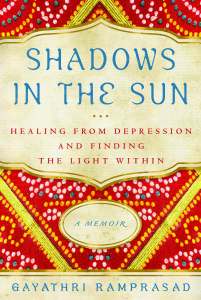
Shadows in the Sun by Gayathri Ramprasad

ShadowsInTheSun_cmyk

FOR IMMEDIATE RELEASE:

“Dear Mother Earth,” I plead, “please take me back into your womb.” I clear the ground around me and start digging furiously with my hands. I don’t remember how long I sat there digging my grave. As the evening light fades, so does my memory. I vaguely recall Ram and my friend Latha carrying me forcibly into the house.

Americans have become immune to the terms, drugs, and behaviors associated with depression even as its reputation has grown as a debilitating and sometimes fatal mental illness. But in India and elsewhere the stigma associated with this condition is cultural and runs deep. In a sweeping narrative that spans the globe from Bangalore to Portland, Oregon, Gayathri Ramprasad shares her harrowing journey through depression to recovery in a new memoir entitled SHADOWS IN THE SUN: Healing from Depression and Finding the Light Within (Hazelden Publishing; March 4, 2014; $14.95). Her story shows how denial and ignorance about mental health issues, especially among those who love us, can be deadly.

Gayathri Ramprasad was a blossoming, young Indian girl being raised by a loving family steeped in tradition. But as she grew into an adolescent, she found it more and more difficult to cope with the routine ups and downs of life. The “tipping point” came after Ramprasad failed a class at college and became inconsolable. Unlike a reasonably healthy person, who might be upset at first but come to a place of acceptance and a rational state of mind, Gayathri could not stop herself from obsessing over her failure and what this would mean to her future and her family.

This event is one of many that Gayathri shares in SHADOWS IN THE SUN. Her arranged marriage, moving to America, and the birth of her first child all led to suicidal ideation and attempts, along with varying degrees of fear and chaos for her growing family. At her lowest point, she was found digging a grave for herself in her backyard with her bare hands, mumbling unintelligibly, with her young daughter sitting in the house alone.

Institutionalized for a second time, Ramprasad met the people she needed in her life—people who  delivered the messages she desperately had to internalize and believe. Finally, her life began anew as she drew on both her rich Hindu heritage and the best of Western medicine to find “the light within,” an emotional and spiritual awakening from the torture she had felt inside for nearly thirty years. Overtime, she learned how to respect her illness without letting it dominate her existence. She also realized she wasn’t alone. Having grown up in a family and culture that initially thought her illness was a curse, was surprised to learn that her father, brother, and sister all struggled with mental illness.

Today Gayathri Ramprasad is president of ASHA International, a nonprofit organization she founded, whose mission is her calling—to promote personal, organizational, and community wellness around the world. She knows that even in India today, there is little tolerance for people with mental illness and that the stigmas are almost too much for tormented individuals to bear. With the support of family, community, faith, and knowledge, she believes that people can overcome their mental health issues and lead healthy, thriving lives. SHADOWS IN THE SUN illustrates how troubled a person can become and how wonderful it is when she can walk out of the darkness and into the light of recovery.

ABOUT THE AUTHOR
Gayathri Ramprasad is the founder and president of ASHA International (myasha.org), a nonprofit organization promoting personal, organizational, and community wellness. Gayathri received her first undergraduate degree in science from Bangalore University in India. At George Fox University in Newberg, Oregon, she earned a second undergraduate degree in management and information systems and a master’s in business administration. She is a member of the Global Speakers Federation and winner of the prestigious Eli Lilly Welcome Back Award for Lifetime Achievement and the Voice Award for Consumer Leadership sponsored by the Substance Abuse and Mental Health Services Administration.

ABOUT HAZELDEN
Hazelden Publishing is part of the Hazelden Foundation, a national nonprofit organization founded in 1949 that helps people reclaim their lives from the disease of addiction. With over 60 years of knowledge and experience, Hazelden offers a comprehensive approach to addiction that addresses the full range of patient, family, and professional needs, including treatment and continuing care for youth and adults, research, higher education, public education and advocacy, and publishing. It has facilities in Minnesota, Oregon, Illinois, Florida, and New York.

Craving by Omar Manejwala, M.D.

FOR IMMEDIATE RELEASE:

Chocolate, sex, travel, a glass of wine, a new pair of shoes, french fries—these are all things people may indulge in from time to time.  For the most part, feeding these desires is a simple way to enjoy life, but what happens when a little pleasure becomes an overwhelming need that cannot be satisfied?  Omar Manejwala, M.D., the chief medical officer at Catasys and the author of the new book CRAVING: Why We Can’t Seem to Get Enough (Hazelden Publishing; April 2013; $14.95; Original Trade Paperback), defines craving as a “strong desire that, if unfulfilled, produces a powerful physical and mental suffering.”  A true craving can lead to a serious problem. According to Manejwala, current research shows that psychology, culture and brain chemistry hold the clues to why we may never be satisfied—but they also show how we can overcome these urges and compulsions.

In CRAVING Manejwala explains that the brain can turn against us, undermining our goals.  Using our experiences, habits and biology, our brain influences what we crave—and whether we will be able to stop—by pulling the strings of pleasure and pain, thereby creating a cycle that is hard to break.  All sorts of factors can be involved in the creation of this pattern. Some are genetic, and others come from the environment in which we were raised. But one thing doctors now know is that we can change what we want by “teaching” our brain how to think differently.  Eventually, Manejwala maintains, we can lose interest in the very thing that used to control us.  A desperate need has the potential to fade—not to be completely forgotten, but certainly not to continue to dominate our everyday life.

Some of the questions Manejwala covers in CRAVING are:

  • How and why do our brains drive our behavior?
  • What are the warning signs that a craving is evolving into an addiction?
  • Why is craving the most difficult component of addiction to address?
  • How can we change the parts of the brain that fuel our cravings?
  • What are some beliefs about cravings that recent research has disproven? (For example, it’s not necessarily true that we want what we can’t have.)
  • What simple steps can we take that can aid in the longer-term process of living without constant craving?

CRAVING will help everyone, from the person who just wants to manage their cravings to prevent them from getting out of control, to an addict (alcoholic, compulsive overeater, shopaholic, gambler, sex-addict, etc.) who has crossed the line and needs to completely reeducate his brain.  Manejwala believes that everyone can get satisfaction by learning what it is they really need and how to get it.

Omar Manejwala, M.D., is the senior vice president and chief medical officer of Catasys in Los Angeles and is the former medical director at Hazelden Foundation.  Dr. Manejwala is a transformative public speaker and appears frequently in the national media to address the topic of addiction and compulsive behaviors.