What is a book publicist?

press release closeup illustration design graphicMany years ago, I was working as a “temp” while I made time to pursue a career in acting and musical theater.  I believe the man I worked for took pity on me and was compelled to offer me a full-time job with benefits (I had none at the time).  Deep down, I knew that I wanted a bit of security.

That job was at Disney Publishing and I eventually made my way to become Assistant to the Associate Publisher of Hyperion Books for Children.  After a couple of months he said, “I need someone to publicize the launch of a new imprint called Jump at the Sun.” And I thought, What is that and how do I do it?

One of the things I learned early on as a novice publicist is a formula that consists of the following:

  1. Read the book.
  2. Write a press release.
  3. Put together a media list of book reviewers, journalists, producers in radio and television, and online news sites.
  4. Send copies of the book to people on the media list.
  5. Call to follow up and try to schedule reviews and/or interviews for the author.

At the very least, this is what a publicist can do for you and your book, regardless of how it’s published. But there is more to the job than making a few phone calls and setting up an itinerary. A publicist needs to know how to tell your/your book’s story well enough to attract the attention of as many people as possible through media placements, outreach to groups and organizations, online communities, and through social media.  This is true no matter how your book is published, but whichever path you choose, there are a few differences between how you and your book may be received in the world.  To make it simple, I’ll break things down into  what you can expect from a publicist whether your book is traditionally or independently published.

Traditional

  • To be traditionally published means you have signed a contract with a full-service publishing house which will perform the editing, production, marketing and promotion of your title.  There are many levels of “houses” from the big six to the smaller literary places like Unbridled or Bellevue.  If this is your path,  here are some things that you can generally expect from a publicist:Being introduced approximately six months ahead of publication.
  • Discussing with your publicist your book, background, credentials, personal contacts, previous media history, and anything else that might help the campaign.
  • A press kit is written and approved.  This may include a press release, Q&A with you, bio, pictures, praise sheets, etc.
  • He will set up tour appearances if you are going on a book tour.
  • He will put together a media list. A local area media list based on where you currently live, where you grew up, where you went to college, where you got married, etc., will be culled as well.   He will also coordinate with the online marketing person to discuss what blogs and websites she might be working with to promote you.
  • Books will be sent and pitching will start, and hopefully reviews and interviews will be scheduled for you.

The majority of the work will take place ahead of publication and will last about a month or six weeks into the book’s release depending on the book and how successful sales are.In recent years more and more authors are hiring their own publicists because they want someone who is reporting to them directly who may be able to accomplish more or supplement the work of their assigned person.  In fact, an editor I had lunch with recently recommends that many of his authors consider doing so.  The reality is an “in-house” publicist is only going to devote the amount of time and expertise that she can based on what other projects she has going on at the time; whether or not your title is a lead for the list; and her level of experience.  All of the checklist items should be accomplished, but will this person research every possible angle? Online community? Niche media outlet? Event venue? How about after the month runs out and you still want to work on promotion.  Will she be given the time to continue?

Keep in mind that a traditional house is very bottom-line oriented ; when deciding where to spend its publishing dollars, it must consider all of the other titles on its list.  A smaller, independent publishing house may have more time to devote to you (because their list is smaller). The caveat here is that part of the success of any campaign will be about how well the publisher is recognized in the media, how well you are known in the outside world as an author or expert, and how good the book is!

Self-Published/Independent

What I’ve listed above is  also applicable for self-published books in terms of the actual “to do” items, but the media strategy is a bit different. Having said that, here is what  your publicist can arrange for you:

  • Blog and website reviews.
  • Online radio and video interviews.
  • Terrestrial (or traditional) radio and TV appearances, if there is a news hook.
  • Social media that maximizes your Twitter; Facebook; Linked In; Pinterest; and/or Tumblr platforms and followers.
  • Content marketing where your original essay or blog is pitched to different websites that appreciate the subject of your book and can post for their audience.

Now, I’ve learned from experience that self-published books will almost never be reviewed in traditional print outlets, so you may have to let go of the fantasy of your cover appearing in the New York Times Book Review. But I promise you there are other ways to reach your audience. My advice to every author is to write your book, because that is the first and hardest thing to do.  Without your story, there is nothing any of us publicists can do.

As for how to go about hiring a publicist…well, that is a post for another day.

What can you expect from your publicist?

publicistAn author contacted me this week to find out if I had written anything about what you can expect from a publicist, because she is disillusioned with her firm and isn’t sure if her feelings are justified.  Initially I responded that it is difficult to gauge because some of it depends on what is being promoted; the experience level of the person or firm handling the campaign; what you specifically have hired the firm to do; and how much you are paying for the service.  Upon thinking about these things I thought expanding them as much as I can in a blog may be helpful and if anyone has a question about it, you can just ask me (claire@clairemckinneypr.com).

What are you promoting?

As an executive in the publicity world and having nearly twenty years of experience I can say honestly that what you are selling does make a major difference.  You can’t pretend something is what it is not–that backfires tremendously–and you can’t manufacture credentials or a person’s background to raise their platform.  Either you have the goods to work with or you don’t.

Now there are some gray areas in that we are all trained to “spin”, which for me means turning everything we have to work with into an advantage whether through messaging or opportunities.  So for example, a person who isn’t a Ph.D. but who has a great concept can still be successful out there with the right promotional package and by hitting the right target audience.

Experience of the person or firm

When I first started doing publicity I had no idea of what I was doing or what it really meant.  My mentor started me out with a press release and a list and said start pitching this list.  My goal was to get the top TV, radio, and print in every market and as much national media as I could secure.  I got on the phone and methodically went down the line, marking comments on my list, and bookings into my schedules.  Was that all there was to it?

In my second job, my boss enlightened me to the fact that there was strategy involved in media and that you could shift directions if one way wasn’t working.  I thought huh? Strategy?  Anyway, I think you get my point as after many jobs and my own company later, I am a very, very good PR strategist.

What have you hired a publicist to do?

There are many ways to structure the contract you make with your publicist.  Some people charge a monthly retainer; some a project fee; some hourly; some a la carte; etc. You need to keep in mind a couple of things about what a publicist does and how this all works, in my article Do You Know What a Book Publicist Does?

It all comes down to hours in a day, and the job of a publicist is very labor intensive.  When you retain a person or firm you need to explain what you want to have done and if you aren’t sure of what’s possible, that person should be able to give you an idea based on his/her experience.  Here is a quick list of some things you can/can not expect from your publicist:

1. You CAN NOT expect a set number of quantifiable results.  You can’t purchase five feature stories from a publicist. That would be considered advertising, and it would cost you a heck of a lot more money.

2. You CAN secure a radio satellite company to book radio for you and they may be able to say they will get “x” number of interviews, but you CAN NOT expect they will all be national or on good stations.  In some cases companies will not be able to book what they quoted and they may give you a refund for part of your contract.

3. You CAN NOT expect your publicist to be on call 24/7 unless you are a celebrity; it’s a matter of national security; or you are on tour at his/her discretion and your cab dumps you off in the middle of the desert at 2:00AM (hope there is cell service out there).

4. You CAN ask for regular written updates of his/her activities and outcomes as well as an accounting of where things stand with different parts of the campaign.

5. You CAN NOT expect your publicist to know everything so it’s okay if you have some ideas that he/she hasn’t thought of yet.  You CAN collaborate which can lead to greater success.

6. You absolutely CAN expect that your publicist will be the expert who can guide you and explain what is likely and what is unlikely.  You should be able to expect honesty from the person you are hiring.

Money, money, money

I have an earlier blog post about how much it costs to hire a publicist.  I will be trite here, but the old adage “you get what you pay for” still stands.  I have a rule when I buy something I consider major (like an appliance).  I never buy the cheapest one and I never buy the most expensive.  You have to figure if you call five people and they are all more expensive than one, the one is charging too little for what the job truly entails and you will not be happy.  Do you have to hire the $50,000 firm in the big city?  No. But do be practical and do consider that we are all trying to earn a living and experience, resources, and track record do play a part in what it is going to cost you.

Have I answered your question JH?  I hope I have come close.  Again, public relations and publicity is a tough industry where a firm may devote many hours and get few immediate results.  In general, if you don’t feel comfortable with the person/firm you are working with you should try to have a candid conversation about your concerns.  If you don’t think you are the right fit for each other, you may want to part ways.

Will publicists work with your book if you self-publish?

medialogosSomeone recently sent me an article by Philippa Rees that comes up on the ALLi site as “the failure of a publicist” though the title is “Why PR Firms Should Embrace Self-Publishing.” I feel the need to respond banging my drum a bit on the subject of what a publicist does as well as what’s been changing in the marketplace.

The Marketplace

Things have not just changed, they are constantly changing when it comes to publicity and promotion.  If you read PR Daily (which I do) there are many articles about the way our jobs are changing as promoters. For my part, I am consistently tweaking the services I offer and training my staff so that we are able to take advantage of all the tools there are these days that can be used to market and publicize a book and author.

Book reviews for as long as I’ve been in publishing (almost 20 years) have been dicey.  About seven years ago a book my department worked on was featured as the cover of the New York Times Book Review.  Did it boost sales?  Nope.  Here’s the secret to print reviews&emdash;there have to be a ton of them to really make an impact.

When I worked for Putnam Publishing, which at that time published Tom Clancy, Patricia Cornwell, Ram Dass, TD Jakes, and others, all of the publicists had a required “hit list.”  So the expectation was on EVERY book you would strive to get reviews in Time, Newsweek, People, the New York Times (daily and book review), the New Yorker, Chicago Tribune, Boston Globe, LA Times, Washington Post, and the San Francisco Chronicle.  These were the biggest papers with the biggest book review sections.  If you didn’t get attention for your books in these places, then you were supposed to get feedback as to why not.

Putnam was the best training I ever received as a publicist, and this list was made for a reason.  Because these publications could reach a HUGE amount of eyeballspeople who wouldn’t necessarily read the reviews, but they would see the book title and author in a very important paper.

Things work the same online and a PR firm that has done its homework is going to find the best outlets to pitch that will reach the biggest audience.

Ms. Rees’s Article

There is a lot more I could say about ways in which we can work on self-published titles to make them work in the media, but it would make for too long of a post.  In terms of Ms. Rees’s article there are some warning signs or red flags that I see in her telling of the story.

One concern in Ms. Rees’s article highlights on the publicist not wanting to say the book was self-published.  Personally, I don’t feel the need to underline whether a book is traditionally or self-published.  I just list the publisher like I would on any release.  I do encourage my self-published clients to form a “company” versus just putting their own names on the spine, because it is important to deliver a professional product.  It shows that you care as much about your writing as we should.

The other subject is the “two-month campaign.” There is no such thing.  I wouldn’t even sell this idea to an author.  My minimum contract is three months but this also depends on the scope of work and the kind of book.  Some books may need more time.  I tell authors upfront what I want to do and what I expect to have happen in a given time frame.  When I don’t know something, I tell them that as well.

So Ms. Rees is correct that a “two-month” campaign at the beginning of the publication wasn’t going to be effective.  Also, the whole concept of “launch” really needs to be kept tied to boats and not books.  It creates a misconception about the amount of fanfare that is going to occur at publication.

A longer view which Ms. Rees also discusses is what has happened since the publication.  It is possible that the publicist’s outreach garnered a bit of attention from other outlets.  Not everything is about confirmed media at first; sowing the seeds and spreading some word of mouth is necessary.  Also, there were a couple of interviews, albeit not successful ones.

I can definitely see what was frustrating about this experience, but generalizing or lumping publicists into one bag here may be premature.  I have definitely heard many different stories from my client’s about their conversations with other PR professionals before they found my team, and a lot of times they are turned down right away if self-published.

Bottom Line

If you are looking for a publicist, look for one who has worked with self-published titles.  Ask what kind of success she/he has had.  Also find out what kinds of books she/he actually likes to work on, and finally, what specifically are the reasonable goals within a given time frame.

Self Publishing Case Study #2: How many books should you be selling?

how-to-self-publish-your-book-pop_8319I’ve been thinking about a client of mine who came to me with a lovely novel that he decided to self-publish.  In our initial conversations he expressed knowledge of how he knew this was a venture that might not yield a lot in the way of money, but for a man in his position it wasn’t a major concern.  In a few words, he had resources.
With the ability to pay for a well-conceived package for the book, an editor, a web designer, and of course a public relations and marketing team, he was off to a really good start.

My client had a great idea for a book.  It was a story about a single mother and her sons, one of whom was really good at sports, especially baseball.  Throw in some flashback scenes with a few old-time famous players and you have the perfect combination of adult/YA crossover with a sports theme. His book had the opportunity for different targeted markets.

Our planning started in July and August with a fully fleshed-out timeline.  The production aspects related to the book were completed by October including the edited copy, interior design, and jacket design/copy/etc.  In September we started kicking off the marketing with a two-tiered plan of big-mouth and bookseller outreach as well as setting up and starting the social media.

We encouraged our author to blog; we handled his tweets; we advised on Facebook posts.  We also connected him to some online outlets that wanted original blog entries.  We did a customized press kit with peanuts, cracker jacks, a baseball card, and a copy of the book to select retailers and media people.  We helped manage the first event, which took place near his home and was in a perfect location–a gated community with a captive audience that added to the friends, family, and other contacts who were able to attend.

In December, shortly after the official “launch” of the book, he sold over 500 copies.  In the months following up until March/April he was selling as few as 20 per month to as many as 80 (approximate numbers here but in the correct range).

We set up a blog review tour leading into the winter months, which certainly helped with the sales, but it was slow, especially after the initial blast of December that had been made possible by the marketing lead up and tapping all of those friends, family, and contacts.

Was he happy?  No.  He was looking for a steady sale of around 800 copies a month.  In the publishing industry in general (traditional and non-) that is not an easy number to reach, especially for a novel by a new author.

So, here’s what happened.  He was asked to blog and write pieces for a couple of websites, which he didn’t really see the value in doing.  He wasn’t motivated to keep up with social media, and it really wasn’t his thing (which is fine, not everyone loves the 140 character story).  He decided to work with an ad agency to put notices on some of the higher end literary websites, which we didn’t recommend because the book itself wasn’t right for that market.  Eventually, I think he gave up.

This was a hard one for me because I really liked the book and thought it had a nice slow burn happening with additional opportunities to feed the fire.  As anyone who self-publishes knows, overnight success is rarely possible.  Usually you have to be willing to keep your day job and work at marketing in the off hours.  Will you make money from your first book (or any book for that matter)?  According to a survey from Digital Book World and Writer’s Digest, most authors (both traditional and non-) are making less than $10,000 a year.

The biggest lesson here for me was to make sure that everyone I work with understands the realities of the publishing industry.  Sometimes having an alternative goal to selling books, like raising your public profile or getting pitched to do speaking engagements, helps authors because it is part of a bigger plan for their careers.  With fiction this is a bit more difficult.  The whole process is a journey and although experts can advise and predict based on their experiences, there are many factors that go into the success of a book.  But when your book is selling, even just 20 copies a month, it is something to be proud of and it means there is potential there.  It’s a question of tapping into it, nursing it along, and not letting it go for anything.

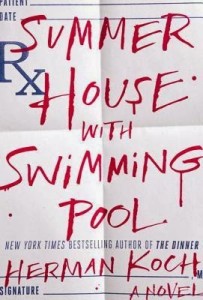
Book Review: Summer House with Swimming Pool by Herman Koch

summerhouseswimming

“A look says more than words alone. That’s a cliche, of course. But a cliche, also says more than words alone.” 

Summer House with Swimming Pool begins and ends with a murder.

Herman Koch’s new novel is the story of Marc, a family doctor who is smart and self-aware to a fault. He has a heightened awareness of other people and their actions combined with a compulsive need to invent fictional scenarios about these people.  This leads him to a conscious state where it is difficult to determine fact from fiction.

Marc focuses most of his obsessive thinking on Ralph Meier who he actually murdered–an important fact we learn in the very first chapter. The subsequent chapters backtrack to several months before to engage the reader in the events leading to Ralph’s death.

Being a doctor for years is clearly starting to get to Marc, and he is simultaneously apathetic and disgusted by his patients.  He is also well-known by celebrities for being a “go-to” guy who will write prescriptions for whatever they want. Ralph Meier is a high-profile Shakespearean actor who stops into Marc’s office one day in search of a drug prescription, and their interaction begins an unsteady friendship between the two men.

A film and television star, Ralph has a pretty and obnoxious wife, Judith, who doesn’t know about Ralph’s piggish appreciation for women–including Marc’s wife Caroline and their two teenage daughters. Ralph and Judith invite Marc’s family to their summer house near the beach, which has a swimming pool that wins his daughters over, resulting in the family deciding to stay longer than initially planned.

Although Ralph is easily the most detestable character in the book, Marc is not so innocent himself; we learn right from the beginning that he murdered Ralph due to a medical error, although it’s clear that Marc has no regrets about the incident. Marc also takes part in an affair with Judith behind Caroline’s back.

Marc is also excessively passive when it comes to taking action. Although he has some evidence that Ralph may be making sexual advances towards his daughters, he says and does nothing. Instead, Marc would rather brood about Ralph’s alleged pedophilia and analyze the situation that may be happening to his daughters. But for the majority of the book, he doesn’t lift a finger towards Ralph.

Only when his 14-year-old daughter Julia is attacked on the beach one night does Marc confront Ralph about molesting his daughter. He quickly–weakly–backs down when Ralph gets angry at him, opting to take the passive route of packing up and leaving with his family to go back home. After the drama of the summer house dies down, Ralph boldly returns to see Marc at his office, and we soon discover that even the way Marc murders Ralph is as passive as a murder can be.

Summer House with Swimming Pool is a book that I like to think Albert Camus would enjoy. The narrator’s emotions are not necessary indifferent towards his friends and family, but his actions are. Marc is a man who is angry at Ralph’s perversion and disgusted by his existence, but he does nothing to stop Ralph from leering at Caroline and their teenage daughters. The narrator’s viewpoint and Koch’s writing style reminds me of The Stranger and Mersault, the indifferent and passive protagonist who is always thinking, but never doing, resigned to his fate and never seeking a different outcome. If you are searching for similar authors to Camus, Herman Koch and his new novel Summer House with Swimming Pool is the perfect fix.