Are readers more likely to be cat or dog people?

A client of ours writes a mystery series that is funny, engaging, and every book so far has gotten an endorsement from Janet Evanovich — you can’t get much better than that in this genre.  Her new book, which will be released this fall, has all of the great trappings we’ve come to expect, plus a special guest: a cat.Now, I haven’t seen the manuscript yet, as it is still in the midst of the writing/editing process, but I was thrilled with the idea that a furry friend was going to be a part of the excitement.In the spirit of cat love, we suggested she might start a campaign involving cat photo submissions on her Facebook page and a Pinterest board featuring our fine whiskered friends.  Well, she has been bombarded with submissions and it made me wonder: is there a link between the kind of animal lover you are, and reading?

IMG_1364This is one of my cats (I have two).  I mean, look at this face—it screams mystery, intrigue, and “I am just going to sit near you and sleep for the next several hours so you can be engrossed in your book.” Not to predict my future as a stereotypical cat lady or anything, but I can tell you that cats are the perfect reading companions—quiet, manageable in size, and they sleep for about eighteen hours a day.
IMG_1360
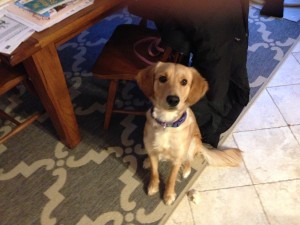
Dogs on the other hand are an entirely different story.  This is my dog Katie.  I love her to death, but I think dogs work against our ability to read.  First of all anything I do that doesn’t involve her makes her jealous, so a book, although not a threatening cat or dog rival, is still something that takes my attention from her antics.  Just when I get into the good part of a novel, a slimy, oinking pig toy is tossed in my lap for playtime.  If I don’t give her what she wants, she will likely eat a roll of paper towels or hold my daughter’s favorite stuffed animal hostage.  No amount of doggie biscuits alone will meet her ransom demands.

Do readers = cat people? What kinds of books might a cat or a dog person like the most?  I am going to suggest that more people who like/own cats read books, especially mysteries.  Dogs are a bit more of a challenge. What do you think? To share your dog/cat photos with us, Tweet us your opinions or pet pictures @McKinneyPR!

Claire McKinney Returns to PubSense Summit

PubSense Summit
1 King St., Suite 507
Charleston, SC 29401 www.PubSenseSummit.com
Contact: Shari Stauch Ph: 843.834.1872
Email: shari@pubsensesummit.com

MCKINNEY PR FOUNDER TO SPEAK AT PUBSENSE SUMMIT:
Claire McKinney Joins Stellar Faculty at Premiere Publishing Conference in Charleston, SC

PubSense_logoFebruary 8, 2015, CHARLESTON, SC – The PubSense Summit™ team is thrilled to announce that Founder of Claire McKinney Public Relations Claire McKinney will be a featured speaker at the 2015 PubSense Summit taking place at the Francis Marion Hotel in Charleston, SC, March 22-24, 2015! The Summit is comprised of the best and brightest people in publishing, author branding and book marketing, all gathered to help emerging authors and small publishers make sense of a rapidly shifting landscape.

Claire has been working in public relations and publicity for eighteen years and recently she was invited to be on the Today Show to provide expert commentary for a segment on self-publishing. She has worked at several publishing houses promoting books and authors, and creating branding campaigns. Prior to starting her own company she was the VP, Director of Publicity for Henry Holt and Company and the Director of Publicity for Miramax Books. Since the inception of Claire McKinney PR, LLC, Claire has broadened her work outside the realm of books to include organizations and products related to education and health, as well as corporate branding campaigns.

Claire will be a featured speaker on two panels: Book and Author PR: Making Sense of Press Kits, Launch Parties and More and Master Class—Increasing Exposure Part 2. In each, Claire will draw from her nearly two decades of public relations experience to share her insights on how authors can draw attention to their books and capitalize on it.

“Claire has led numerous authors in successful book campaigns,” said Brenda McClain, PubSense Summit partner. “She gets results for her clients, and we’re confident she’ll show our attendees how to achieve results as well. We can’t wait to meet her in Charleston.”

CONFERENCE QUICK LINKS:
Who Should Attend the PubSense Summit?
What Can I Learn at PubSense Summit?
PubSense Summit Registration Contest
2015 Faculty at a Glance
2015 Schedule at a Glance

Who writes better: men or women?

My husband has accused me of not answering questions directly, but rather giving a roundabout answer full of explanation first and eventually getting to what he wants to know.  Sometimes I wonder if all he really hears is “…………………………………………….. (answer) ……………………..”

So perhaps then it is not a big surprise to find that in a recent study of 3000 men and women conducted by Grammarly, 74.80% of those respondents found that women are more likely to write long, descriptive sentences.  Women are also more likely to write about people versus things and focus on character development instead of, as per the study, getting “to the point” or crafting a plot driven narrative.

Maybe it’s a Mars/Venus thing based in psychology, sociology, and biology?  Having been told I have a –ahem- problem getting to the point, I guess I can identify with these results, but does it mean women are better writers?

Certainly the female gender has been praised with having “better” communication and “people” skills, which is probably why so many of us are in the public relations field, television, radio, human resources, social work, etc.  But writing, while clearly a tool for exchanging ideas and passing on information, is an art form.

Are men or women better musicians?  Better actors? Better painters? I don’t think you can make a determination.  If writing is a creative art, then I think it is very difficult to try to assess the success of one sex over the other.   MenvsWomen_Writers_infographic

Image via Grammarly.


Publish, Release, Launch: Some of The What and When of Book Publishing

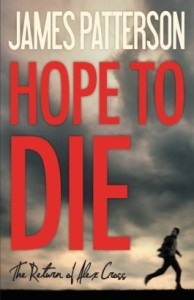
james pattersonI will let you in on a secret: no one, not even the big publishers, know exactly when to publish a book.  Yes, there are some givens, like making sure you are able to get into holiday and other promotions like Christmas, Mother’s Day, Father’s Day, etc. Then there are books by authors that consumers are trained to buy in a certain month based on its availability.  I’m talking about Michael Connelly, James Patterson, and others who write at least one book per year.
I should also mention the reason a book is usually published on a certain date is because of marketing and publicity reasons.  We try to get books out there when they will be featured most prominently and when the media are interested in what the titles and authors have to say. 

For self-published authors I recommend that they publish the book as soon as it is ready.  I call this a “soft publication.”   Your “media date” or “hard publication” can be  whenever you think the stars are going to align with media coverage and the success of your marketing—or when you think you can sell the most books!

I’m going to try to break down what the norms are in terms of publication months, but first I need to address some lingo that is tossed around and needs to be clarified.

Publication: This means that your book is on the market and available for sale via any and all distribution channels.

Release: This usually means the date that books are shipped from a distribution center to online and retail stores.  However, I’ve seen it used interchangeably with “publication” but for some people it means something different.  I’m not saying you are wrong for using the word, but knowing that there are other meanings out there might help clear up some confusion.

Launch: This term is a pet peeve of mine, because using this word implies there is some kind of event attached to the publication of your book.  If you are a celebrity or famous person and/or your book has breaking news that is going to dictate an entire news cycle, then perhaps “launch” is a good word to use.  But I caution people about calling publication a launch, because I think there are inherent expectations associated with using the word that can potentially be cause for disappointment.  

* * *

Having said all of this, here are some monthly breakdowns that I have generally experienced as the accepted publication patterns:

January (Or “New Year, New You”)

Self-help; diet; inspirational; business—if you fit into this category, this is what the media are generally interested in, and it’s what consumers are thinking about.

February 

Self-help associated with relationships; debut authors; business; fiction—if you are a debut author, this month is not as full of new titles and there may be more promotion and media opportunities for you as a result.

March

Debut authors; mysteries; fiction

April

Women’s fiction

May

Beach reads; women’s fiction; biographies; books on mountain climbing

June

More beach reads; women’s fiction; biographies or other non-fiction that will appeal to male readers on vacation or for Father’s Day

July

Quieter month better for debut authors; more of what you saw in June

August

Debut authors; education related titles; narrative non-fiction by lesser known writers

September

Public affairs and politics; serial authors in fiction and non-fiction; cooking; highly publicized titles by debut authors

October

More politics; cooking; big non-fiction titles by well-known personalities and writers; higher end photography books; art books

November

Photography; art; gift books; big names; and anything else you can think of that will sell in the current budget year

December

Good month for lesser known authors.  A variety of books are published including late comers for Christmas or those titles that people want to get a jump on for January

* * *

You may notice that the categories are not always dictated firmly in one month or another—this is what I mean about the secret.  In the end what everyone wants to do is get the book out there at the best possible moment.  But you need to consider what you can control and what you can’t.  After you make your best educated decision, you have to go with it and plan as if it will be the biggest “launch” you’ve ever seen! 😉

Amazon dispute shows the separate and not always equal sides of publishing

amazonI have had the pleasure of growing up in the publishing industry before and during the digital age.  When I first started working in the industry, there were Barnes & Noble, Borders, and a slew of independents.  Then came Walmart, Target, Costco, etc. Along came Amazon during and in-between the others.

About ten years ago I had a conversation with a reporter, off-the-record, about how Barnes & Noble (B&N) was dictating what people read.  The premium merchandising space was paid for, and yet the books that got to sit there had to be approved.  For example, I recently read something about the big fiction buyer at B&N and how much she controlled what made it and what did not.

If B&N said “we don’t like the jacket”, you changed it.  If they said they would take “x” number of copies, you adjusted your print runs accordingly.  At that time, B&N controlled about 20% of retail sales; Borders about 5%; Amazon about 5%; and the rest was in the wholesalers, clubs, libraries, and independent stores.

Today it appears that Amazon controls around 20% of the retail market.  I don’t know the other figures, but I’ve seen this one reported in various places.  Now the screaming has begun about Amazon dictating what we read, but this is unlikely to happen.

For one thing, Amazon does not discriminate (unless in a pricing war).  If you are a teeny little publisher, a self-published author, a big five or six publisher–it does not matter.  You can sell your book through the e-tailers.  I would argue that there are more different books available for sale on Amazon (or other e-tailers) than in any other traditional store.

In some ways, these e-tailer outlets may deserve a bit of credit for the rise of small indys and self-published authors.  What would have happened to Lisa Genova or the Shades of Grey erotica books without the online marketplace? How would we have learned about them and acquired our own copies?  Certainly no brick and mortar store was going to order these books for their shelves.  There are far too many books already.

It’s interesting to see how clear the divide is between the authors fighting Amazon and those quietly supporting it.  The 900 members of the Guild that approached the DOJ about a suit against the e-tailer for monopolistic practices are mostly, if not all, traditionally-published authors, publishing veterans, and the like.  And I wonder if it is really about the price so much as it is about the principle of the matter.  Is this ultimately an issue of “Why should we let them tell us what to do?”

For the independently published authors, it is not a principle: it is a matter of fulfilling a dream, perhaps earning a living, and generally more practical concerns. The people who are out there trying to get their voices heard have a vehicle to sell their books: the internet.  They set their prices, pay their portion to the e-tailers, and hope to make a buck or two in the end.

I have been reading and watching all that has transpired even as I hear the authors talk about their Amazon rankings, and getting reviewers to post on their pages so they can move even higher.  I can’t condone the behavior of a big giant like Amazon (forcing a publisher to bend to its will), but neither can I condemn it, because it is having some positive effect.

I will posit this:  What if publishers had been able to brand themselves a bit and increase their own market share?  What if the market is becoming truly segmented to the point where publishing books will be about which format to focus on as much as what books?  What if hardcovers were printed mainly for collectors and die hard fans in small runs and paperbacks were made available for some books right away (and e-books as well of course)?  What if the print book was made available first and the e-book three months later like a DVD or download on Netflix?

And on a much bigger picture scale:  Is the art of reading dying?  Is publishing dying?  I’ve heard some people say it, but I refuse to believe it.  Especially when I see my daughter who has access to a Kindle and a tablet, but who chooses to read physical books that I race to the store (a real store) to buy for her.  She takes her little book light on the school bus in the morning and has a lamp attached to her bed for nighttime.  She’s 10.  A pre-teen I met told me he likes all three formats of books (hardcover, soft, and digital) but for different reasons.  So he will have different titles in different formats or even all three for varying reasons.

I think things have been changing and that’s hard for an industry reaching toward 200 years old.  But I think the bad press on all sides is not doing anything for the cause and hopefully sooner rather than later we will all be able to move on.