
Language is important: Don’t call me “stupid”!

2016 Presidential Election
Image via someecards.com

As a PR person I am trained to manipulate the English language to express what I need  to, at any given moment.  As a kid I was pushed by parents who spoke foreign languages and insisted on proper verb agreement and other basic grammatical sentence structures. Since I spend so much time glued to the words I hear, it’s very depressing to find nearly every newscaster and public speaker having trouble with “there is” and “there are”.  For all of you out there who know what I mean, thank you!  For everyone else, “there is” is to be used when speaking of a single item; “there are” is for more than one.  There is a storm brewing.  There are a lot of storms in the Midwest at this time of year.  Slurring the words together in a slack form of “there’s” is not acceptable and does not excuse anyone from knowing that “is” relates to one thing.

It has been particularly interesting to watch the Presidential races of the past decade.  First Obama’s team put together a brilliant campaign aimed at those people who are heard less in this country.  Many of them are on the internet, and between using social media well, and papering low-income neighborhoods, Obama was able to win the election…twice.

2016 is shaping up to be a different animal altogether.  This is the age of referring to the words of co-candidates as “stupid” and telling your constituents to “sit down and shut up”.  If I thought our problems rested in the way we put together sentences, I was so wrong.  We seem to have fallen into a schoolyard, junior-high world where sounding like you just came out of the local pub on the corner and you are yelling at a guy who ran the stop sign, is the way to express yourself.

Who cares if your suit costs $5000? If you comb your hair or even take a shower?  Gee whiz, how debasing it is to watch potential world leaders practically pull out “nah, nah, nah, nah, nah, naaahhhh” (again, schoolyard).

And even funnier is to hear them actually put each other down.  A newscaster recently pointed out that “sit down and shut up” didn’t think  “stupid” has the proper “temperament” for the presidency.  Meanwhile another candidate from the other party decided to go all out and label a domestic terrorist a religious zealot commonly found in occupied territories in the Middle East.

Have these public figures spent too much time on Instagram and Snapchat?  Or have they made too many appearances on late night television? I’m not sure what’s happening, but it is sad to watch “stupid”, “sit down and shut up” and “religious zealot” standing at their podiums trying to tell us that they are going to take the country in a direction that will provide for the common welfare and keep us safe.  I mean, really, it isn’t proper for us to be pointing and laughing behind our hands when our national leaders are trying to be serious.

 

Happy Summer Vacation! 5 Things PR People Can Do To Keep Sane While Away

You made it.  The big day is finally here and you are headed out of town for a little bit of rest and relaxation.  But even though you try to schedule time off when the world is in slow mo’ it’s still very difficult to “unplug.”  In fact, I would say checking out completely is more nerve-wracking than actually making a plan to address work in a reasonable way while you are on vacation.

Sometimes though, the best of intentions can’t keep you from a media crisis, like the time I had to deal with producers at the Today show while at Busch Gardens in Virginia.  Or the time I had to walk a client through a national media booking from the porch of a general store in North Carolina.

Barring any emergencies, here are 5 things you can do to keep sane and to make re-entry as pain-free as possible:

  1. Make a list of what you want to get done before you leave, and a list of what you are going to do the week you get back.  The “before you leave” list is clear, but more importantly, start thinking of what will need to be done when you return so you have some organization in place.
  2. Download files from your work computer. If you work on a computer at the office, make sure you download anything you might need onto a USB drive.  This way if someone wants a press release or a file and there isn’t anyone else to send it, you will be able to fulfill the request.  Even if you don’t have a personal laptop to bring along, there are internet cafés everywhere.
  3. Arrange for a roaming plan on your phone. This is especially true if you are traveling internationally.  Roaming charges are steep for cell phones, but many carriers offer packages that limit the cost/minute of phone time and allow for some data downloads.  You still need to wrestle the phone away from your tween and teen, but you can be available for emergencies without having to worry about hundreds of dollars on your phone bill.
  4. Out of office on your computer.  This may seem like common sense, but you may forget to do it anyway.  Leave an out-of-office on your email and make sure it sends “once per email address.”  There is nothing more annoying than repeatedly getting messages from someone who is not there!  Make sure to explain that you are on vacation and that so-and-so can be reached to help with immediate needs.  Or you can say you are checking email daily, but for emergencies you can be reached at “x” number.  Most people won’t call you.
  5. Check email twice a day. In his book The 4-Hour Work Week, Tim Ferriss says that you need to limit the amount of times you check your email in order to be more efficient.  What better time to practice this approach than vacation?  So instead of hitting that “inbox” button over and over when you are waiting for someone to get back to you, plan on reading emails in the morning and in the late afternoon or early evening.

BONUS TIP: Relax, have fun, and enjoy this well-deserved respite.  Being in your shoes myself, I am sure you deserve it!

Explore Your World Outside of the Office (Preferably in a Different State)

PubSense_logoMy mother used to say that taking a vacation or a break from your regular routine was especially good for gaining perspective, opening doors, and making decisions.  I think business trips can do the same if planned well and embarked upon with an open mind.
Last week I attended the PubSense Summit in Charleston, SC as a faculty member, sharing expertise on marketing and publicity in the world of books, brands, and authors.  It is a really great conference, in part because the people who organize it are so nice and smart—they saw a dearth of opportunities for writers to get together in the southeast, so they produced their own event.  Necessity is the mother of invention (another thing my mother says, and yours too perhaps).
I met some interesting writers—traditionally and independently published, and I had the opportunity to attend some lectures as well.  Today I will try to impart some of the things I took away from the trip that may be helpful to you.
Things to note about Publishers Weekly:  They receive about 1,000 books per week and only 9,000 are reviewed in the magazine and online combined.  Also, they only pull 25% of what they receive for consideration.  I asked about the criteria for selection and was told that some of this information is not to be disclosed, but I did learn that sloppy press kits or unreadable review copies will most likely be tossed to the reject pile.
Also, they have instituted an automated, online service called Galley Tracker, which is where you register the books you are submitting for review.  Then you are free to check the status of your book, thereby eliminating the need to actually call an editor at the magazine.
Audio on Amazon:  Amazon has an independent way for you to publish your book in audio format. In fact, Joanna Penn said that you should try to make your books available in as many digital formats as possible because people in India or Germany may want your book even if it is only available in English.  The more versions and outlets = exponential sales for the author.
Move over Bookbub:  I had to great fortune to run into a couple from North Carolina who directed me to breakfast off-site (I have a horrible sense of direction).  They run a company called FreeBooksy.  This is a service similar to Bookbub, except the cost for authors and publishers is lower and I believe that it is easier to get into a promotion.  They have access to at least 200,000 readers, but you can click on their name to go to the website for more info.
National Pencil Day? Who knew: There is a website where you can find out what is special about a given month, week, or day in a given year.  If you want to try to find a media hook for promotion, check out Brownielocks.
Another review outlet for literary and other kinds of books: I don’t particularly like authors having to pay for reviews, but when a review outlet is willing to go the extra mile it is worth it.  Chanticleer Reviews will cover your book and market the review through their publication, Amazon, and social media channels.  They have high credibility and other outlets may run their pieces as well. Plus, the people who run the publication are true book lovers, and want to do whatever they can to help authors.

More on blogging: You want to start a blog, but where do you begin?

BLOGA couple of weeks ago we discussed how to maximize your efforts if you have a blog. But if you want to create a blog, where do you begin?
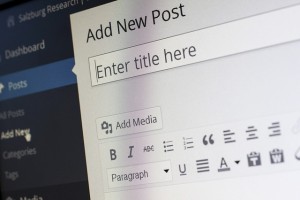
Blogging can be fun activity, but for some, it’s a chore they feel they “have to do” as a writer. If you’re an indie or self-published author—or even traditionally published—you’ve probably spent a fair chunk of time (and your life) working on your book. Where can you get inspiration for a blog? Why should you even have a blog in the first place?

Including a blog on your author website is an invitation to others to join your conversation, and having a blog can help you in the long run as an author. It can cull relationships with other authors, bloggers, and book lovers, and also build an audience for your brand. As we’ve said before, everything in social media links back to everything else—and a blog can be the center of that online map. Here are some ideas and tips for conceiving a blog:

  • Researching a blogging platform. We use WordPress, which has proven to be great for us. But there are a bunch of other free blogging platforms: Tumblr, Blogspot, Blogger, etc. Play around with a few to see which one you like best.
  • Brainstorm an editorial calendar. It can be as simple as printing out a free online monthly calendar and jotting down one or two ideas you’d like to discuss each week.
  • Sit down and write! Sitting down and actually committing to the task is, more often than not, the hardest part of writing. An idea might just come to you when you open a new document.
  • Write what you know. Not necessarily advice you should take when writing a fantasy novel (I’m pretty sure JK Rowling did not write what she knew when she created the Hogwarts world that we all pretend to live in), but writing about why you love coffee could end up being a really fun blog post.
  • Hammer it out in one session. If you leave one day a week free to write 3 or 4 blog posts you have yourself set for the next week. Schedule each blog post over the course of a few days.
  • Write about writing. Did you have a particularly successful day of writing? Are you having trouble with plot development for a new project? Are you struggling with some character names? Write about it—it might even help you solve your own problem. (Or maybe someone will come up with a grand solution in the comments section!)
  • Review. If you read books or watch movies on a daily basis, why not put your opinions to paper (or rather, keyboard)? Reviewing is good filler for in-between posts.

It’s a good idea to have a blog if you’re a writer, but if you really don’t want to do it, you don’t have to. There are other ways to gain an audience or fan base. If you initially started a blog and you just are not feeling it, don’t leave it up on your website.  It looks sloppy to have something that was last updated in December 2013. If you want to keep your blog posts up but no longer plan on blogging, create a “farewell” blog piece for your faithful readers and archive the rest.

If you do plan to keep a blog on your website, make sure that you have the time to commit to it, even if your strategy is to post once a week or every other week. I see so many blogs on author websites that aren’t updated for months at a time, sometimes even years!

Also, if you don’t have a website yet, don’t let that stop you.  Go ahead and set up your blog-site and get started.  You may find that the blog itself is your best way to connect with your audience and fans, thereby saving you development dollars in the long run!

Marketing, Advertising, & Public Relations: Can you have one & not the others?

6898557627_dd28a9530f_b
Image by Aimee Kinsella via Flickr.

Although we are a consumer-driven economy and the competition for customers is fierce, most of us probably don’t know what is actually entailed in reaching a customer base. There are two major umbrellas that serve this purpose, and they are huge industries: Marketing and Public Relations.

Many things fall into these two camps.  According to the American Marketing Association, Marketing is defined as “the activity, set of institutions, and processes for creating, communicating, delivering, and exchanging offerings that have value for customers, clients, partners, and society at large.”   Hmmm. The one I found on Yahoo is somewhat clearer: “The strategic functions involved in identifying and appealing to particular groups of consumers, often including activities such as advertising, branding, pricing, and sales.”

For people who are trying to sell product, especially intellectual property which includes books, there are several ways to go about digging in to the marketing functions.  Let’s break the definitions down and identify what each piece is intended to do.

“Appealing to particular groups” or Finding your audience.  Who is going to buy what you are selling?  Be interested in what you have to say?  What are these people talking about now, and where can you find them?

“Branding”: Deciding what you or your product represents.  How do you want to package yourself?  What packaging is appropriate?  What kind of image are you and your product presenting?  How can you directly appeal to your audience?  Answer these questions and create the right language and visuals that go along with the brand.

“Pricing and sales”:  You don’t want to charge too little, but also not more than the market will bear.  Research what comparable services or products are going for in the marketplace and set your price accordingly.

“Advertising”: In my experience, advertising only works when you are working with something or someone who is already a known entity in the target market.  Otherwise, unless you have a major budget for an ad campaign, you are trying to create awareness about something that no one knows about.  This is better suited to publicity and the public relations industry.

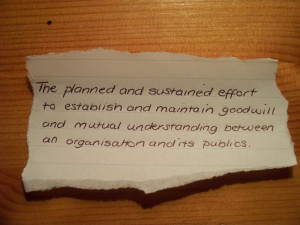
Public Relations is “the art or science of establishing and promoting a favorable relationship with the public, ” again according to Yahoo.  I love the thought of it being an art or science.  In layman’s terms, pr is about getting the word out through appropriate messaging across many channels.  First you create the story or message you want to broadcast and then, via traditional and digital media, you propagate the information.

Messaging comes in many different forms including press releases, original articles, podcasts, and videos that you can market across the media world.  Again, knowing your audience is key because you have to find a way to communicate with them that will get them to take notice of what you are trying to say/sell.

Publicity is all about media and comes into play after the message is ready.  Here there are similarities to the way advertising works, except that publicity incorporates or generates stories.  Advertising can be very one-dimensional and static (like a full page ad in the NY Times).

Generally, given the number of outlets there are to promote things and the many different ways you can reach people through social media channels, you are likely to need a combination of some or all of the above.  In order to meet the changing needs of clients and authors, I’ve become a hybrid publicist who is well versed in public relations strategies and marketing.  It’s a lot more interesting to know how all the pieces fit together and hugely gratifying when you can be successful and see results.