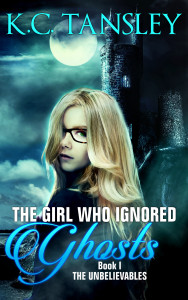
The Girl Who Ignored Ghosts by K.C. Tansley

The Girl Who Ignored Ghosts“Ghosts don’t exist. They can’t touch me. They can’t hurt me. They aren’t real.”

This simple mantra has saved 17-year-old Kat Preston’s life on countless occasions. It stops ghosts, which she calls “unbelievables,” from manifesting in her world. Refusing to believe is the only way to protect herself from the ghost that tried to steal her life when she was a child.

But some things can’t be ignored, and the ghosts are done letting Kat have a normal life in this YA time-travel murder mystery THE GIRL WHO IGNORED GHOSTS (Beckett Publishing Group, ISBN 978-1-943024-00-1, August 2015), by award-winning author Kourtney Heintz as K.C. Tansley.  When Kat is alone doing research for her prep school teacher on the mysterious wedding night murders at Castle Creighton in 1886, the ghosts make their reappearance. Kat uses everything she has to keep them from breaking through, but she knows this project is putting her ghost-free world at risk.

Working on this project is the stepping-stone to her dream school, Georgetown University; however, Kat can’t keep the ghosts away and solve the wedding night murders that are steeped in unbelievables. The mysterious deaths of the bride and groom, Cassie Mallory and Sebastian Radcliffe, triggered the “Radcliffe Curse”—a curse that leaves the oldest Radcliffe male heir dead on his 23rd birthday. This project sets Kat on a collision course with all the unbelievables.

If it were just about the murders, Kat might be able to say no. But when she finds out that the ghost who saved her life and the ghost who nearly stole her life were both bridesmaids at this wedding, the murders become about her and the ghosts. Kat has to find out what happened to those ghosts and why they both came into her life, and that means being a part of this on-site research project.

Kat and the uptight project leader Evan trek to Castle Creighton, an old fortress that resides off the coast of Connecticut on the remote Isle of Acacia. The project takes a dark twist when they learn they only have a few weeks to solve the mystery before the current Radcliffe heir, Joshua, dies on his 23rd birthday.

Kat must confront her fear of the unbelievables when she’s yanked through a magic portal and Evan follows her. They are transported back in time to 1886 and fall into the bodies of two wedding guests, Toria Langley and Alistair Kingsley. With each passing day, Kat and Evan grow weaker and have more and more trouble staying in control of the bodies they inhabit. Together, the must try to figure out the wedding night murders before they fade into the past forever.

THE GIRL WHO IGNORED GHOSTS is a fast-paced YA time-travel murder mystery novel that combines time-traveling, paranormal, and gothic mystery genres to weave a tale full of ancestral curses, powerful spells, strange connections, and inherited surprises.

About Kourtney Heintz:
Kourtney Heintz is the award-winning author of the novel The Six Train to Wisconsin (2013), and is debuting her first Young Adult novel THE GIRL WHO IGNORED GHOSTS under the pseudonym K.C. Tansley. Heintz is a member of the Mystery Writers of America, Romance Writers of America, and the Society of Children’s Book Writers and Illustrators. She lives with her warrior lapdog, Emerson, on a hill in Connecticut. Never one to say no to a road trip, she’s climbed the Great Wall twice, hopped on the Sound of Music tour in Salzburg, and danced the night away in the dunes of Cape Hatteras. She loves the ocean and hates the sun, which makes for interesting beach days. Find out more at: http://kourtneyheintz.com/

THE GIRL WHO IGNORED GHOSTS
By K.C. Tansley
Beckett Publishing Group
Publication Date: August 1st, 2015
ISBN: 978-1-943024-00-1
Original Trade Paperback & E-book
Price: $11.99
258  pages

###

Explore Your World Outside of the Office (Preferably in a Different State)

PubSense_logoMy mother used to say that taking a vacation or a break from your regular routine was especially good for gaining perspective, opening doors, and making decisions.  I think business trips can do the same if planned well and embarked upon with an open mind.
Last week I attended the PubSense Summit in Charleston, SC as a faculty member, sharing expertise on marketing and publicity in the world of books, brands, and authors.  It is a really great conference, in part because the people who organize it are so nice and smart—they saw a dearth of opportunities for writers to get together in the southeast, so they produced their own event.  Necessity is the mother of invention (another thing my mother says, and yours too perhaps).
I met some interesting writers—traditionally and independently published, and I had the opportunity to attend some lectures as well.  Today I will try to impart some of the things I took away from the trip that may be helpful to you.
Things to note about Publishers Weekly:  They receive about 1,000 books per week and only 9,000 are reviewed in the magazine and online combined.  Also, they only pull 25% of what they receive for consideration.  I asked about the criteria for selection and was told that some of this information is not to be disclosed, but I did learn that sloppy press kits or unreadable review copies will most likely be tossed to the reject pile.
Also, they have instituted an automated, online service called Galley Tracker, which is where you register the books you are submitting for review.  Then you are free to check the status of your book, thereby eliminating the need to actually call an editor at the magazine.
Audio on Amazon:  Amazon has an independent way for you to publish your book in audio format. In fact, Joanna Penn said that you should try to make your books available in as many digital formats as possible because people in India or Germany may want your book even if it is only available in English.  The more versions and outlets = exponential sales for the author.
Move over Bookbub:  I had to great fortune to run into a couple from North Carolina who directed me to breakfast off-site (I have a horrible sense of direction).  They run a company called FreeBooksy.  This is a service similar to Bookbub, except the cost for authors and publishers is lower and I believe that it is easier to get into a promotion.  They have access to at least 200,000 readers, but you can click on their name to go to the website for more info.
National Pencil Day? Who knew: There is a website where you can find out what is special about a given month, week, or day in a given year.  If you want to try to find a media hook for promotion, check out Brownielocks.
Another review outlet for literary and other kinds of books: I don’t particularly like authors having to pay for reviews, but when a review outlet is willing to go the extra mile it is worth it.  Chanticleer Reviews will cover your book and market the review through their publication, Amazon, and social media channels.  They have high credibility and other outlets may run their pieces as well. Plus, the people who run the publication are true book lovers, and want to do whatever they can to help authors.

Publishing Slang You Didn’t Know (But Were Too Afraid To Ask)

Sometimes words in the publishing industry don’t mean what you think they mean.
Why-We-Don-t-Like-Fast-Track-It-s-a-Total-Failure_blog_post_fullWidth

Isn’t a book release the same thing as a publication date?   Is there really a difference between an ARC and a galley?   Below is an infographic we made to clear up some of the publishing industry slang that can be confusing.   What words do publishers and media outlets use that mystify you? Tweet us your questions @McKinneyPR!

Infographic-Publishing Vocab1

Are readers more likely to be cat or dog people?

A client of ours writes a mystery series that is funny, engaging, and every book so far has gotten an endorsement from Janet Evanovich — you can’t get much better than that in this genre.  Her new book, which will be released this fall, has all of the great trappings we’ve come to expect, plus a special guest: a cat.Now, I haven’t seen the manuscript yet, as it is still in the midst of the writing/editing process, but I was thrilled with the idea that a furry friend was going to be a part of the excitement.In the spirit of cat love, we suggested she might start a campaign involving cat photo submissions on her Facebook page and a Pinterest board featuring our fine whiskered friends.  Well, she has been bombarded with submissions and it made me wonder: is there a link between the kind of animal lover you are, and reading?

IMG_1364This is one of my cats (I have two).  I mean, look at this face—it screams mystery, intrigue, and “I am just going to sit near you and sleep for the next several hours so you can be engrossed in your book.” Not to predict my future as a stereotypical cat lady or anything, but I can tell you that cats are the perfect reading companions—quiet, manageable in size, and they sleep for about eighteen hours a day.
IMG_1360
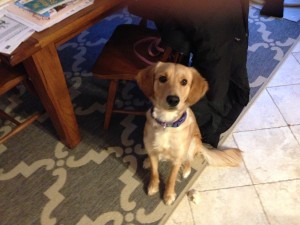
Dogs on the other hand are an entirely different story.  This is my dog Katie.  I love her to death, but I think dogs work against our ability to read.  First of all anything I do that doesn’t involve her makes her jealous, so a book, although not a threatening cat or dog rival, is still something that takes my attention from her antics.  Just when I get into the good part of a novel, a slimy, oinking pig toy is tossed in my lap for playtime.  If I don’t give her what she wants, she will likely eat a roll of paper towels or hold my daughter’s favorite stuffed animal hostage.  No amount of doggie biscuits alone will meet her ransom demands.

Do readers = cat people? What kinds of books might a cat or a dog person like the most?  I am going to suggest that more people who like/own cats read books, especially mysteries.  Dogs are a bit more of a challenge. What do you think? To share your dog/cat photos with us, Tweet us your opinions or pet pictures @McKinneyPR!

More on blogging: You want to start a blog, but where do you begin?

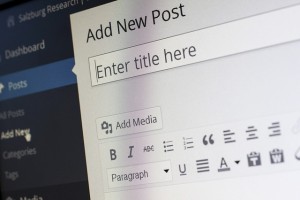
BLOGA couple of weeks ago we discussed how to maximize your efforts if you have a blog. But if you want to create a blog, where do you begin?

Blogging can be fun activity, but for some, it’s a chore they feel they “have to do” as a writer. If you’re an indie or self-published author—or even traditionally published—you’ve probably spent a fair chunk of time (and your life) working on your book. Where can you get inspiration for a blog? Why should you even have a blog in the first place?

Including a blog on your author website is an invitation to others to join your conversation, and having a blog can help you in the long run as an author. It can cull relationships with other authors, bloggers, and book lovers, and also build an audience for your brand. As we’ve said before, everything in social media links back to everything else—and a blog can be the center of that online map. Here are some ideas and tips for conceiving a blog:

  • Researching a blogging platform. We use WordPress, which has proven to be great for us. But there are a bunch of other free blogging platforms: Tumblr, Blogspot, Blogger, etc. Play around with a few to see which one you like best.
  • Brainstorm an editorial calendar. It can be as simple as printing out a free online monthly calendar and jotting down one or two ideas you’d like to discuss each week.
  • Sit down and write! Sitting down and actually committing to the task is, more often than not, the hardest part of writing. An idea might just come to you when you open a new document.
  • Write what you know. Not necessarily advice you should take when writing a fantasy novel (I’m pretty sure JK Rowling did not write what she knew when she created the Hogwarts world that we all pretend to live in), but writing about why you love coffee could end up being a really fun blog post.
  • Hammer it out in one session. If you leave one day a week free to write 3 or 4 blog posts you have yourself set for the next week. Schedule each blog post over the course of a few days.
  • Write about writing. Did you have a particularly successful day of writing? Are you having trouble with plot development for a new project? Are you struggling with some character names? Write about it—it might even help you solve your own problem. (Or maybe someone will come up with a grand solution in the comments section!)
  • Review. If you read books or watch movies on a daily basis, why not put your opinions to paper (or rather, keyboard)? Reviewing is good filler for in-between posts.

It’s a good idea to have a blog if you’re a writer, but if you really don’t want to do it, you don’t have to. There are other ways to gain an audience or fan base. If you initially started a blog and you just are not feeling it, don’t leave it up on your website.  It looks sloppy to have something that was last updated in December 2013. If you want to keep your blog posts up but no longer plan on blogging, create a “farewell” blog piece for your faithful readers and archive the rest.

If you do plan to keep a blog on your website, make sure that you have the time to commit to it, even if your strategy is to post once a week or every other week. I see so many blogs on author websites that aren’t updated for months at a time, sometimes even years!

Also, if you don’t have a website yet, don’t let that stop you.  Go ahead and set up your blog-site and get started.  You may find that the blog itself is your best way to connect with your audience and fans, thereby saving you development dollars in the long run!