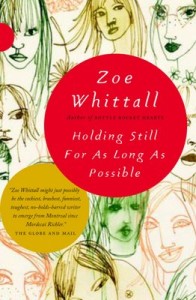
Review: Holding Still for as Long as Possible by Zoe Whittall

Holding+Still+cover
Zoe Whittall/House of Anansi Press

“But we were both shaken by what we’d seen. It was as though someone had peeled the mask off certainty and our first-world assumptions about safety. Bombs happened halfway around the globe, not nearby. We were used to abstract faraway injustices and violence. We’d been cushioned our whole lives, and had no idea how to act or what to think when faced with this disaster.

Today that episode felt like ten years ago, not four. I felt so much older, drinking whiskey in the morning so I could sleep. The things I’d seen since then. The gnawing in my bones of a kind of tired I knew wasn’t healthy. But I was so used to it, it didn’t matter anymore.”

Holding Still for as Long as Possible

Holding Still for as Long as Possible by Zoe Whittall is a portrait of three people representative of the “Y” generation. These twenty somethings grew up after 9/11 in a society generously prescribing pills to numb the pain and anxiety of living in a culture on steroids. Texting their relationships; dousing their troubles with alcohol; and living in a fog, confused about who they really are, Whittal’s characters tenuously maintain a grip on their daily lives.

Josh is a female-to-male transgender working as a paramedic, and he spends his days and nights becoming more emotionally-distant from the terrible events he sees. He starts to take his emotionally detached feelings into his relationship with Amy, a rich girl who is trying to live a cool bohemian city life with her amateur film-making career. At the same time Josh is becoming distant, Amy is finding being around Josh is annoying her for no apparent reason other than their relationship is starting to become less exciting and more mundane.

Billy (real name: Hilary) gets thrown into the mix when her long-time girlfriend Marie breaks up with her and Billy moves in with Roxy, who is Amy and Josh’s mutual friend. Billy is a has-been child music star who came and went from the spotlight quickly, and blew all her money in the process. Billy tries to make a living by going to college (and constantly skipping classes) and working as a waitress, but her full-blown anxiety doesn’t leave her alone, and her ex-girlfriend is the only one who understands how to deal with Billy and her anxiety issues.

One day Billy runs into Josh and Amy on the street and immediately garners a crush on Josh. She’s too flirtatious and self-absorbed to care enough about Amy’s feelings, and immediately goes for the kill, although she uses self-protecting language at first, such as “Josh, I think you and I are going to know each other for a long time.” Josh and Amy eventually break up, though they remain together in the same apartment, and Josh continues dating Billy, even though Billy is starting to drive him crazy because she won’t fully commit to the relationship. In a turn of events, Amy starts seeing Billy’s ex, Maria, and although Amy acts as though she’s dating Maria because she’s attracted to her, there’s an obvious dig towards Billy for stealing Josh.

The characters in Holding Still for as Long as Possible are the most selfish people in Toronto, possibly the world. They never think about each others feelings, but only how others will react to them. Although Billy is self-absorbed and wallows in her anxiety problems, Josh is the most self-centered and insecure of the group. His skills as a paramedic of being unaffected by other people’s trauma has left him incapable of being expressive outside of the workplace. His impassive personality brought on the majority of difficulties in his and Amy’s romance. At one point she asks him, “You just don’t want me to be happy, do you?”

Josh is so consumed with his own feelings for the two women in his life that he doesn’t even see the problems going on in his coworkers’ lives, such as not knowing fellow paramedic Dave was gay—and even then, Josh turned it into his own problem: “He looked at me, just as close, and all of a sudden I saw that he knew about me.” When Billy and Amy get into an accident with a truck, Josh is furious at Amy for surviving, and although he is upset that Billy may not live, he still manages to spin his emotions so that he’s the victim and Billy’s the bad one: “For some reason, she thinks Billy’s the victim of my uncertainty when it’s the other way around.”

In the end, Billy and Josh deserve each other: they’re both so interested in themselves that they are a reflection of one another, two people Amy never should have had to deal with in the first place. Holding Still for as Long as Possible is a great book: there is a lot of egotism, but it’s all so realistic you’ll find yourself hating and loving the characters as they go about their daily lives and messed-up relationships. The book is honest as it captures the raw emotions of these young people who are just trying to survive the monotonous lives in which they exist. They are all trying to figure out who they want to be, but they don’t have the ability for introspection and deeper thought. Their world of technology and text-messaging, and stuffing real emotions, has left them unable to form bonds with other humans and solve their problems by sharing them face-to-face.
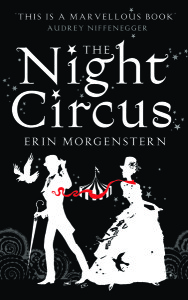
Review: The Night Circus by Erin Morgenstern

Night-Circus-UK-cover
Erin Morgenstern/Random House LLC

“The sign says Hall of Mirrors, but when you enter you find it is more than a simple hall. You are met not with floor-length unadorned planes of mirrored glass, as you half expected, but hundreds of mirrors of varying sizes and shapes, each in a different frame.

As you move past one mirror reflecting your boots, the mirror next to it shows only empty spaces and the mirrors on the other side. Your scarf is not present in one mirror and then it returns in the next….

As you walk farther into the room it becomes a field of endless  streetlamps, the stripes repeating in fractal patterns, over and over and over.” –The Night Circus

The Night Circus by Erin Morgenstern is a beautifully crafted story over 500 pages long, yet it certainly doesn’t feel that way. The novel is about two lovers bound to each other since childhood.  Unbeknownst to them their destinies are intertwined in a competition where only one can be left standing.

Celia is a young girl when her mother commits suicide and she is brought to her father, the great illusionist Prospero the Enchanter, otherwise known as Hector Bowen. To win a bet  with the man only known throughout the book as Alexander or Mr. A.H, Bowen commits his 6-year-old daughter to participate in a game. Alexander adopts his player, Marco, just three years Celia’s senior, from an orphanage and begins to teach him all he knows about illusions.

When the Night Circus first came to fruition from the great and eccentric mind of Chandresh Christoph Lefevre, Celia and Marco had no idea that they were to be pitted against each other.  But once the event was underway for several years they both realized that they had been set in opposition to each other from the start.  They fall in love anyway and their relationship sets off a domino effect of events resulting most often in the deaths of beloved circus employees.

While Marco, with his magical intelligence, holds the circus together with charms (such as slowing down everyone’s aging so that the circus employees seems to never mature), Celia goes on a mission to end the competition and keep everyone she loves out of harm’s way.

The plot is the strongest part of the book and it will keep the reader flipping the pages. Morgenstern undoubtedly knew exactly how the circus should unfold in her mind, and how the characters’ interactions and discoveries of each other would develop. Another striking aspect of the book is Morgenstern’s brilliant descriptions: each beautiful old home, every musty library, and every inch of the circus is filled with beautiful images, and she makes it easy for one to sink into the setting: “The entire compartment looks like an explosion in a library, piles of books and paper amongst the velvet-covered benches and polished-wood tables. The light dances around the room with the motion of the train, bouncing off the crystal chandeliers.”

The characters are all quirky in their own ways, but while reading the story, I felt like I never got to really know Marco and Celia as well as I would have liked. They’re in love, but you never really see it develop except for the fact that they were smitten the moment they saw each other. But they hardly have interactions in which I felt their love over their lust. The rest of the cast and their reasons for being in The Night Circus, however, are so worth the read.

Before you pick up the other well-known circus-related book Water for Elephants, pick up The Night Circus. The Night Circus is much more fun and has a more developed story and setting, and believe me, by the end of it you’ll be hoping for a movie, and a real Night Circus you can attend.

We were “slammed”…

If you subscribe to a utility company, for home or business, beware because “slamming” does exist and it is incredibly annoying to deal with.

We recently opened an office and purchased a “business bundle” with Verizon.  A month or so after we were set up and running a phone call came in to the office.  An employee answered and her end of the conversation which went something like this…

“Yes, we do have Verizon.”

“Yes, that is the company name.”

“We don’t have any questions about the service.”

etc., etc., etc.

It seemed like a routine customer service call, until the questions became repetitive and went on for longer than what we deemed to be a regular call.  So, she ended the conversation and hung up.

For a few weeks after that, the same person or company kept calling asking the same questions over and over.  The second call we ended within a couple of questions;  The third, maybe after the first question; and the fourth time I recognized the number, picked up the phone and told the person that we were going to take action for solicitation harassment (sounded good at the time) if the person didn’t stop calling.

Shortly thereafter I received a service notice from Verizon that I ignored because I hadn’t ordered any service.  I figured it was just a glitch in the system.  And then the bill came.

The bill was about $100 more than what it should have been, so I took the time to scan all 8 pages and found at the end of the bill a company name I didn’t recognize and substantial charges billed by that company.  I called Verizon and was told that I had changed my long distance service to another carrier and that I was no longer receiving the promotional package rate. WHAT?!  So I told the customer service rep that there was a mistake– I told her about the strange phone calls which must have been related to this, and how incredible this was, and what has this world come to, etc.  She told me that we had been slammed and that she would amend the bill and the previous bill (which I hadn’t checked thoroughly) and would cancel the offending party’s service agreement.  She also put a freeze on my account so that I am the only person who can make service changes.

But that wasn’t all.  A month later another bill came with $50 in charges from this other company.  I called Verizon immediately.

Me: “I called a month ago about a slamming incident and it appears that this other company is still charging me for services that we never ordered.”

Verizon: “I can take care of that for you.”

Me: “Thanks.”

Verizon: “In the future what you might want to do is call this company and cancel the service yourself”.

Me: “But I never ordered the service.”

Verizon: “Right, but you need to cancel it.”

Me: “But isn’t is illegal…what they did?”

Verizon: “Well, yes.”

Me: “But I still need to call them?  I don’t want to call them.  They are a nefarious organization that is doing something illegal.  Why should I have to call them?”

Verizon: “Well, I’m just saying this is how you can best end the problem.”

Me: “Uh huh.  Well, thanks.  Bye.”

I’m waiting for the next bill.

Review: Sharp Objects by Gillian Flynn

SharpObjectsGF“I just think some women aren’t made to be mothers. And some women aren’t made to be daughters.”

-Sharp Objects

There are a fair share of books that use a narcissistic mother character, where the daughter feels misunderstood and unloved by her egotistical mother. Usually when I read books with this sort of mother-daughter relationship I don’t feel much sympathy for the female protagonist because it feels like I just read a book with the same exact relationship except the characters had different names. For instance, the last book I read with a bad mother-daughter relationship was Still Missing by Chevy Stevens. And even though the alcoholic, youth-obsessed mother had her adult daughter kidnapped, I couldn’t feel sorry for either character because I’ve become immune to this dynamic in books.

Gillian Flynn’s book Sharp Objects is an exception. Flynn writes the narcissistic, insane, manipulative mother so well that every time Camille, the protagonist, has any sort of reaction with her mother I not only get nervous for her, but with her. Her disassociation with her mother, Adora, dips and weaves through the entire book, with a sick, twisted ending that you’re expecting, but also sincerely hoping won’t happen. When you finish Sharp Objects you will shudder, and never look at milk or doll houses the same way again.

Camille Preaker hasn’t been home to Wind Gap, Missouri, in eight years, having set up a new life after spending time in a psych hospital for her cutting issues. Instead of cutting lines, though, Camille was cutting words into her skin, the scars of which were still etched into her body: “Richard let out a burp of a laugh, a shocked croak. Unworthy flared up my leg.”  Her sister Marian had died in her teens, something Camille-and the rest of her family-never got over.

Never wanting to set foot in the town she left behind, Camille reluctantly heads back to Wind Gap when her employer, the Chicago Daily Post, hears a rumor about a murder mystery involving two strangled and and deliberately “de-toothed” 13-year-old girls occurring in the same year.  If the paper gets the story, its sales will boom.

While in Wind Gap Camille realizes not much has changed-her mother is still a nervous, self-absorbed woman who has always had everything she wanted delivered on a silver platter. And Camille’s half-sister Amma is the most popular girl in school–a beautiful 13-year-old girl who Camille notices is developing-or already has- psychopathic tendencies: “’Sometimes if you let people do things to you, you’re really doing it to them,’ Amma said, pulling another Blow Pop from her pocket. Cherry. ‘Know what I mean? If someone wants to do fucked-up things to you, and you let them, you’re making them more fucked up. Then you have the control.’” There’s only one thing, however, that the arrogant Amma can’t control: she’ll never live up to her dead sister Marian or the two dead girls, and her overwhelming jealousy makes Amma an even creepier character.

Sharp Objects is a dysfunctional, sickening thriller that engulfs you in its first sentence. I’ll definitely be picking up Flynn’s novels Gone Girl and Dark Places in the near future, and you should be reading Sharp Objects.

Review: A Happy Death by Albert Camus

At Claire McKinneyPR, we love books. Many of our daily conversations revolve around not just the books we work with, but those we read on our own time. So we decided to  post reviews, not just of books that are new, but classics and anything we happened to pick up at a local bookstore or library, and fell in love with.  Enjoy!


Camus Book Cover

“And Mersault, in silence, felt in himself  extreme and violent powers to love, to marvel at this life with its countenance of sunlight and tears, this life in its salt and hot stone-it seemed that by caressing this life, all his powers of love and despair would unite. That was his poverty, that was his sole wealth. As if by writing zero, he was starting over but with a consciousness of his powers and a lucid intoxication which urged him on in the face of his fate.”

-A Happy Death, Pg. 83

Senior year of high school my English honors class was required to read The Stranger by Albert Camus. The class was an hour and twenty minutes long and I devoured the book in less than an hour. No one appeared to have finished reading, and we had the entire eighty minutes for the next class to read the book as well, so I started reading it from the beginning. In two days I read The Stranger three times and loved every moment of it, from the character’s bored relationship with his girlfriend, to his indifferent shooting and slaying of a man, to his listless time spent in jail until his own execution.

A Happy Death by Albert Camus has very similar aspects to The Stranger-in fact, the book jacket quotes Time praising the book as its “preamble.” And a preamble it is: the protagonist, Mersault (who has the same name as the main character in The Stranger) murders an older, invalid man named Zagreus, whom Mersault was slowly befriending, and flees the scene. Mersault, like in The Stranger, has a girlfriend he has no real connection with and keeps around just because he’s bored. A Happy Death unfolds the weeks before and after the cold-blooded murder, not unlike Camus’ more famous piece.

Zagreus was introduced to Mersault by Mersault’s lover, Marthe. Although Mersault and Marthe appear to the audience to be in a relationship-they go to the movies, visit Zagreus, who is Marthe’s old friend, and spend quite a bit of time with each other-Camus uses Marthe to further depict Mersault’s inability to have an honest, loving connection with anyone. Calling someone his “lover” rather than his partner or girlfriend creates a distance between Marthe and Mersault because Mersault is a superficial character who is only interested in satisfying himself and making himself happy-which he is finding increasingly difficult to do in the pages of A Happy Death.

A Happy Death is a short novel with so much compressed into its pages, but Camus delivers with a simple and beautiful unraveling of the character’s story.  Like most of Camus’ works, A Happy Death is worth reading, possibly more than The Stranger is; in its pages is sadness, despair, loneliness, unhappiness, and existentialism. You’ll find yourself feeling sympathetic towards Mersault because he is obviously so lost and drowning in his own inability to understand happiness in both staying and going. His random surges of love and passion for life are constantly pulled back by his weighted despair of being.

Reading this book reminded me quite a few times of the novel Wittgenstein’s Nephew, another existential book by German author Thomas Bernhard. One point in the novel Bernhard states that “I am only happy when I am sitting in the car, between the place I have just left and the place I am driving to. I am happy only when I am travelling.” This line perfectly fits Mersault’s drive to travel as well, for when he is on the train from Prague he keeps switching his tickets to continue his train ride, never deciding to stop anywhere: “not for a single moment was Mersault bored…He loved these long nights when the train rushed along the gleaming rails, roaring through the village stations (pg. 73)…”

Book rating: 5/5
Similar books: Nausea by Jean Paul Sartre, Wittgenstein’s Nephew by Thomas Bernhard