We were “slammed”…

If you subscribe to a utility company, for home or business, beware because “slamming” does exist and it is incredibly annoying to deal with.

We recently opened an office and purchased a “business bundle” with Verizon.  A month or so after we were set up and running a phone call came in to the office.  An employee answered and her end of the conversation which went something like this…

“Yes, we do have Verizon.”

“Yes, that is the company name.”

“We don’t have any questions about the service.”

etc., etc., etc.

It seemed like a routine customer service call, until the questions became repetitive and went on for longer than what we deemed to be a regular call.  So, she ended the conversation and hung up.

For a few weeks after that, the same person or company kept calling asking the same questions over and over.  The second call we ended within a couple of questions;  The third, maybe after the first question; and the fourth time I recognized the number, picked up the phone and told the person that we were going to take action for solicitation harassment (sounded good at the time) if the person didn’t stop calling.

Shortly thereafter I received a service notice from Verizon that I ignored because I hadn’t ordered any service.  I figured it was just a glitch in the system.  And then the bill came.

The bill was about $100 more than what it should have been, so I took the time to scan all 8 pages and found at the end of the bill a company name I didn’t recognize and substantial charges billed by that company.  I called Verizon and was told that I had changed my long distance service to another carrier and that I was no longer receiving the promotional package rate. WHAT?!  So I told the customer service rep that there was a mistake– I told her about the strange phone calls which must have been related to this, and how incredible this was, and what has this world come to, etc.  She told me that we had been slammed and that she would amend the bill and the previous bill (which I hadn’t checked thoroughly) and would cancel the offending party’s service agreement.  She also put a freeze on my account so that I am the only person who can make service changes.

But that wasn’t all.  A month later another bill came with $50 in charges from this other company.  I called Verizon immediately.

Me: “I called a month ago about a slamming incident and it appears that this other company is still charging me for services that we never ordered.”

Verizon: “I can take care of that for you.”

Me: “Thanks.”

Verizon: “In the future what you might want to do is call this company and cancel the service yourself”.

Me: “But I never ordered the service.”

Verizon: “Right, but you need to cancel it.”

Me: “But isn’t is illegal…what they did?”

Verizon: “Well, yes.”

Me: “But I still need to call them?  I don’t want to call them.  They are a nefarious organization that is doing something illegal.  Why should I have to call them?”

Verizon: “Well, I’m just saying this is how you can best end the problem.”

Me: “Uh huh.  Well, thanks.  Bye.”

I’m waiting for the next bill.

Is it J.K. Rowling or isn’t it?

Today’s story about J.K. Rowling and her book The Cuckoo’s Calling, written under the pseudonym Robert Galbraith, is an interesting example of what name recognition and branding can do for authors.  It is also a message for first time writers.  Everyone wants the same kind of attention they see other authors getting in the media based on the quality of their books, but without the fame to go with it, it is a bit more challenging.

I am a self-professed book-nerd.  When I was a kid I was in the Judy Blume and Beverly Cleary fan clubs.  I read all of their books as well as anything by S.E. Hinton, C.S. Lewis, Madeleine L’Engle, and more.  I loved buying the box sets of an author’s work so I could look forward to a somewhat long future with a person whose stories I loved.

I still read that way, when I can.  I will read a single author’s work consistently until I get to one or two books that I don’t like, and then I know it’s time to move on.

But J.K. Rowling is a special case because not only is she a well-known author, she’s sold more books than anyone in my lifetime (or it certainly feels that way).  She’s the George Lucas and Steven Spielberg of books.  The Julia Child and Rocco Dispirito of novels.  The Rolling Stones and the Beatles of wizardry.

So to know that her “debut” novel written under an alias had only sold 1,500 copies in the U.K. since its April publication is a very sobering fact.  Especially since it was reviewed well by the critics and in the U.S., bookstores were promoting it for summer reading.  We know that it was a well-liked book, yet breaking into a strong mid-list showing in sales was not happening, yet.

Today after a reporter got a linguist to compare the writing of The Cuckoo’s Calling to one of the Harry Potter books in order to determine that yes, this book is the real McCoy and the story broke in the papers, the book went up some ridiculous percent on Amazon.com (over 5000%) to the top spots and second print runs, sold out retailers, and all sorts of other book selling mechanisms are going into effect.  The news itself is momentarily taking over the publishing industry.

What can you say to those debut novelists who don’t have J.K. Rowling as their secret identity?  It’s cliche, but success really doesn’t happen overnight.  It takes time building interest, word-of-mouth, reviews, and a reputation that will encourage people to take a chance on a new name. Also keep in mind that 1,500 copies isn’t too shabby for the U.K. market for a debut, which probably would have sold more slowly over time had J.K. Rowling’s identity stayed a secret.

There’s nothing wrong with a certain degree of anonymity.  Rowling appreciated it, and actually savored the opportunity to be treated like a “regular” author.  The grass is truly always greener, isn’t it?

grass

Book Expo: How to make deja-vu new again

I have been attending Book Expo America for a long time, never in the capacity of a show-goer, but always as someone representing a publisher—big or small.  When I started out working in book publishing, we went all out with parties, huge booths, and galley giveaways in the thousands.  It was crazy.

Different publishers had different rules for the staff on the floor too, like no sitting down and to look excited and friendly.  Don’t let any important booksellers or media get by without a handshake, a pitch, and a smile.  Don’t accept unsolicited manuscripts and if pressed, refer potential authors to the editor on duty (who might duck out at that opportune moment).

For the most part, the show has had its fair share of ups and downs, but there are some things that really stood out for me this year and made the experience somewhat new again:

photo

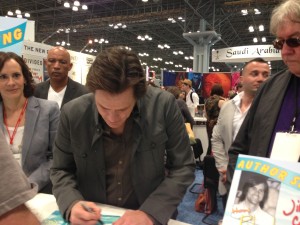
1. The number one thing that made an impact for me this year is that I took someone from my office to the show who had never been there before.  Not only was she excited right up until the day of the show, but she doggedly went to stand in line for Lemony Snicket, Jim Carrey, Ann Romney, R.L. Stine, Snooki from “Jersey Shore,” and Chelsea Handler. She grabbed the swag, like free totes and after the first hour proudly sported an assortment over her arm.  Starstruck and thrilled are the two best words to describe how she seemed to experience the event.  An avid reader and book person, for her this was like heaven on earth.  How fun for me to see the show through her eyes!

2. Saudi Arabia, China, Mexico and other foreign entities have taken over where other domestic publishers have taken to cost-cutting and smaller booths.  Those banners were impressive, even though I did a double take, expecting to see the words Simon and Schuster across the sky.

3. Prospective authors are very different than they used to be. With the business of self-publishing booming, there are less people meekly approaching the booths.  There is definitely a stronger sense of esteem and affirmation—and “I have as much right to be here as anyone else” vibe, which is as it should be.

BEA4. Fewer familiar faces of booksellers and of course, a dearth of book editors.  There are a couple of things happening here.  One is I’m getting older and new people are replacing the old, and two the traditional world of book reviewing and “book media” is still downwardly adjusting for the digital market.  It is as hard as ever to get reviewed in print, but online opportunities continue to grow.

Things are always changing and for me this year the key was definitely to go into the show with an attitude of interest and anticipation.  It is fun to see old friends and co-workers and it is still exciting to be in the midst of an industry that in the face of all the challenges still boasts an underlying passion for its product.

Thank you to the Book Expo team.  See you next year!

When is the right time to hire a book publicist…

I am a fan of the old saying “the early bird gets the worm.”  Corny, yes, but still very true and effective. It isn’t always possible to be out in front of the curve, but when you can plan accordingly it is a simple way to help ensure the success of your book’s publication.  When hiring a book publicist, it is best to secure an expert four to six months ahead of publication–if you are publishing with a traditional publisher. Allow me to break this down.

Your book is in the final editing stages, or it’s about to go to press for bound galleys or ARCs (advanced reading copies)–now is the optimal time to have a publicist ready to start in on your campaign. Why? First of all your publicist needs to read your book, and work with you on a plan and strategy that focuses on the general target audience for the book as well as niche markets. When the galleys come in, you want to be able to send them out right away to the media.

Most publications, especially magazines, require a lead time of four months in order to prepare a review. The review copy has to be received, accepted, sent out for review, the review needs to come in, and space has to be allocated in that publication for the piece. Book review sections in newspapers these days are small and you want to give the editors a chance to take a good look at your book for consideration. If it comes in too close to publication and you aren’t John Irving, you may end up tossed to the side, just because of timing. Bloggers too will get “booked up” and won’t be able to give your book attention for the month of publication if you don’t get them the book with a good solid three to four months lead time.

Ideally you want reviews or articles about you and your book to appear when your book is available in stores and online, especially when there are special marketing programs in place that put your title front and center for consumers to see and buy.

As far as television and radio are concerned, there is a bit more leeway, but keep in mind that a national television show is going to need time to consider your topic and whether or not to have you as a guest.  If you are not a recognized national “name” then it may take quite a while to get a break in a major broadcast venue, if ever, but you still want to have the time to give it a shot.

If you are hoping to set up events with booksellers, your will also need four months to book an event, and this chunk of time may be even longer if you are trying to get into a very competitive store during a busy month of book releases. Book festivals and conferences do their planning six months to a year in advance.

There is so much about marketing a book that is hard to quantify and qualify, but if you give yourself a head start, you will be able to get your book in front of the right people at the right time and if Plan A isn’t working, you will have enough time to shift strategy and still maximize the benefits of a publicity campaign.

Up next news and recommendations for self-published authors looking to hire a publicist…


Do You Know What a Book Publicist Does?

do you know what a book publicist does claire mckinneyDo you know what a book publicist does?

At lunch with publicist friends, there’s one question that we always seem to come back to: does anyone in this business know what we actually do? Yes, yes, every author says they “want” a publicist, but how many authors, and those who work in publishing, actually understand what a publicist does and, more importantly, what can reasonably be expected from their publicity campaign?

People in this business still assume that the only good thing a publicist does is book appearances on Oprah or The Today Show or Good Morning America. Even though this circuit is outdated—Oprah’s show is off the air, GMA is closing in on the Today show’s ratings, and The Early Show just went through another reorganization—people in publishing still think these are the rounds a publicist makes. This needs to change.

I came into the publishing industry accidentally, and took to the role of publicist quite naturally; I’ve been doing it for 15 years. I’ve worked on campaigns for everything from children’s books to adult trade; cookbooks to philosophy; literary fiction to self-help—and I’ll tell you, as I’ve told everyone who has ever worked for me and with me, making a book is a long, difficult process. Nonetheless, when there’s blame about how the final product fares in the market, it often seems to fall on the publicist. Why?

Why would an author take his frustrations out on the person most directly linked to the consumers in the promotional process? Why are the notions of what a publicist does so cloudy? And why, in an era where lack of publicity is repeatedly cited as a major reason books fail, are so many publicists with years of experience struggling to keep their jobs?

Blame it on the digital revolution. Blame it on the homogenized media culture.Blame it on whomever, or whatever, you choose. One problem, aside from the difficulty of getting good publicity for a book, is dealing with misunderstandings about what a publicist can reasonably do.

Right now there are still two overarching umbrellas that classify book publicity campaigns. There are the “big” books that are positioned and sold to the “big” traditional media, and there are all the other books which, well, aren’t sold to the “big” traditional media. And when I say this, I’m not saying all of the other books don’t warrant the same attention as the big books, or that they won’t get a national break, or that they are lesser in any way. I’m saying that, still, there are basically two tracks we think about, and that’s a problem.

That not every book will be right for the “big” media spots is one problem, but it’s a reality. Too often, though, there seems to be anger about not getting those “big” spots instead of an open admission that there are lots of great press hits to be had on smaller outlets and in nontraditional ways.

There are hundreds of television, print, and radio venues, just like the old days. But now there is the Web and there’s social media. You can do viral campaigns. You can give away content in the form of actual books on blogs, or digitally in chapters on any and all Web sites.Can you, the publicist, work with online marketing to coordinate a campaign using some of these tools? Yes. Do you need to know even more people than ever before, collecting contacts like a paper clip magnet? Yes. Will you be able to do this for every book on your list? Probably not. But it would help if these “nontraditional” campaigns stopped being tagged as such. Book publicity is no longer about organizing a “big” or “small” campaign, and publicists know this, but the rest of the industry does not seem to have quite caught up.

So if you are a book publicist like me and one of your more irascible authors is quoted in New York magazine basically saying that publicists are worthless, close your eyes, count to 10, and remember that you have the power and the skill set to go out there and brave a new frontier of media. You will do things that haven’t been done before, and while you accept the well-deserved pat on the back that so rarely comes your way, you can take comfort in the fact that others are quietly saying, “How did she do that?”

(This article was originally published in Publishers Weekly titled “Do You Know What a Book Publicist Does?” and online here.)