
Publicity 101: 4 Things to Consider for Your Author Photo

To have a decent author photo, you don’t need to look like a model or a movie star, but spending the time to get a decent picture will make a difference.  It is important to make the best possible first impression with the media, and your photo is one of the tools you have (in addition to an author bio and press release) to do that.

First, look at other authors’ photos on their books and websites.  See what “look” you like in an author photo.  Decide whether you want something inside against a plain or basic background or if you want to be outdoors, in natural light.  Do you have any current photos that could be good?  Who is going to take the picture?  Will you use a professional photographer or is your spouse handy with a camera or phone?

Here is a checklist that can help you prepare for your author photo:

Image/Wardrobe: You need to have a couple of different outfits on hand so you can compare after you have taken your photos.  Are you writing about secret agents and spies? A sharp suit is probably most appropriate for your author photo.  Are you a chef?  Aprons, hats, and other kitchen accessories would be useful for your wardrobe.  For women: do you wear makeup?  Either go to your local mall’s makeup counter to get a professional’s touch for the day of the photo shoot, or hire a makeup or salon technician for a couple of hours.  For men: you don’t need to worry as much about the makeup, but getting a fresh haircut or considering whether you want that Michael Moore’ish’ baseball hat as a prop is your homework for your shoot.

Scope of picture:  In the performing arts, agents and directors expect what they call “three-quarter shots,” which typically include your face, upper body, and maybe your legs.  You can decide what you want to do, and even if you do a full body picture, you can crop it to meet your needs.  Whatever you do, don’t let anyone twist you into a pretzel or convince you that you look better with your hand on your face.  Just look at the camera and try to be as relaxed as possible, unless there is a connection to your work that requires something unorthodox.  If you are writing a treatise on how to bungee jump and want to be seen hanging from a bridge, please by all means do it.

Location:  Whether you decide on indoors or outdoors, make sure the background of the shot is clean of debris or unnecessary items that will take the focus away from you.  That shiny, peacock print wallpaper might look great around the mantle, but will cause the viewer of the image to peer at your photo and desperately try to figure out what she is seeing.  Garbage cans, giant leaf bags or garden tools, a sink full of dishes, etc. are all “better” viewed off camera.

Photo specs: Your final photo needs to be at least 200 dpi and can be stored as a jpeg, tiff, or gif file on your computer.  A downloadable picture should live on your website under your “media kit” or “press” tab.  Your image should also be found on your book, bio, and any other marketing materials or social media accounts you use.

Do you have to spend a fortune on a professional photo shoot?  Not necessarily, but you should do the best you can to secure the finest image that you feel confident about using in your book and sending to media outlets.

Why We Support Self-Published Authors

Self-Published AuthorsEvery so often, the argument comes up that self-published books shouldn’t be considered authentic, or that self-published authors aren’t serious about their craft.  We have worked with many self-published authors, and here are some reasons why we support them:
Many indie authors have their books put together professionally: A lot of self-published authors invest their time and money to hire a book designer, website designer, copy editor, proofreader, and others, to create a book that is perfect for them and of high quality. All of the authors that we have promoted have had their books professionally edited and designed.

Self-publishing is the route that worked best for them. There are many examples of authors who self-published before their books were published traditionally, like E.L. James and Lisa Geneva, who wrote in a 2008 blog post:

“Before I self-published my first novel, STILL ALICE, last summer, I tried going the traditional route. I spent a year querying literary agents. But no one wanted my book. I was sitting in a holding pattern with a completed novel and no one reading it, waiting to find out if STILL ALICE was ‘good enough,’ waiting to find out if I was a ‘real writer,’ unable to give myself permission to write the next book.”

After self-publishing, Still Alice went on to get published by Simon & Schuster and was turned into an Academy Award-nominated movie starring Julianne Moore. Who is to say that self-publishing a book won’t eventually lead to bigger things…like an Oscar winner?

They are serious about what they are doing. There are many people out there who are great writers who don’t have a publishing deal. Many of those people have very likely crafted their books for years, were involved in writing workshops or groups, or enrolled in MFA creative writing programs. Many of these people have been rejected, and self-publishing is a resource they have available to put their work out there. We have worked with many authors who spent years writing their novels, memoirs, or self-help books, and these books are self-published, well-written, well-edited, and well-designed.

In fact, some may have had a traditional publishing deal that fell through for a number of reasons. Several authors we have worked with were going the traditional publishing route until something happened: an imprint got shut down, an editor passed away, or the author disagreed with what a publisher wanted to do with a storyline.

Self-publishing was a thing before it was a thing. Authors like Benjamin Franklin, Jane Austen, and Walt Whitman had at some point self-published their novels, according to this Poets & Writers article. In the tradition of literature, self-publishing has been a route people have taken for hundreds of years – but with Amazon, print-on-demand, and other resources, it’s had a bigger boon than ever.

Whether you are a traditional or self-published author, writing is hard work. It’s also an art, and it’s up to the author to ultimately decide which way they’d like to display that art.

If you are a writer who has taken or is considering the self-publishing route, do not be discouraged by negative comments. Continue writing, honing your craft, editing your work, and proudly displaying your art—because you wrote a book, and that in itself is a feat!

Book Publishing 101: 5 Ideas for Getting Your Book Sold on Shelves

books sold

Getting your indie or self-published book sold in stores isn’t easy. Even if you have an account with a well-known distributor like Ingram or Baker & Taylor, these wholesalers aren’t going to proactively market your book to libraries and bookstores. They may add your book to a catalog or newsletter (for a fee), but you’ll have to do much, if not all, of the work yourself.

See our detailed blog post about the subject in “Book Publishing 101: Why Your Distribution is Disappointing.”

Here are a few ideas we recommend you try to get your book sold in stores:

  1. Ask friends to request the book. Ask your friends and family from anywhere and everywhere in the country to request or ask about the book in their local bookstore. Also have them try to take the book out at the local library, so that the library can become aware that it exists. This is a small thing, but it’s a great word of mouth tactic.
  2. Visit individual stores. Go to, or call, bookstores and libraries individually and “sell” your book to them. Ask for the manager or book buyer (or, for libraries, to speak to a librarian) and explain who you are and what your book is. Offer to send them some of the reviews, press materials, and a copy for them to check out.
  3. Offer books on consignment. Most booksellers will consider taking the book on consignment, and you may need to fill out an agreement. Make it as easy as possible for the store to say “yes”.
  4. Small press programs. For a chain like Barnes & Noble, check out their small press submission programs, located here on their website.
  5. Book clubs. If you know anyone in a book club, ask them to consider using your book for their club (which may meet in a local bookstore or may least be connected to one). To jump start your research, Where Writers Win has a database of book clubs in each state.

We have worked with many indie authors who have had success hand-selling their book to stores. A few of them have their books carried in regional Barnes & Nobles, or have their book sold by their local indie bookstore. It is a labor intensive process, but if you take it one step at a time you will see results.

Thanks to Sharon Noble, who asked about getting books into stores on the comment section of our Where Writers Win article!

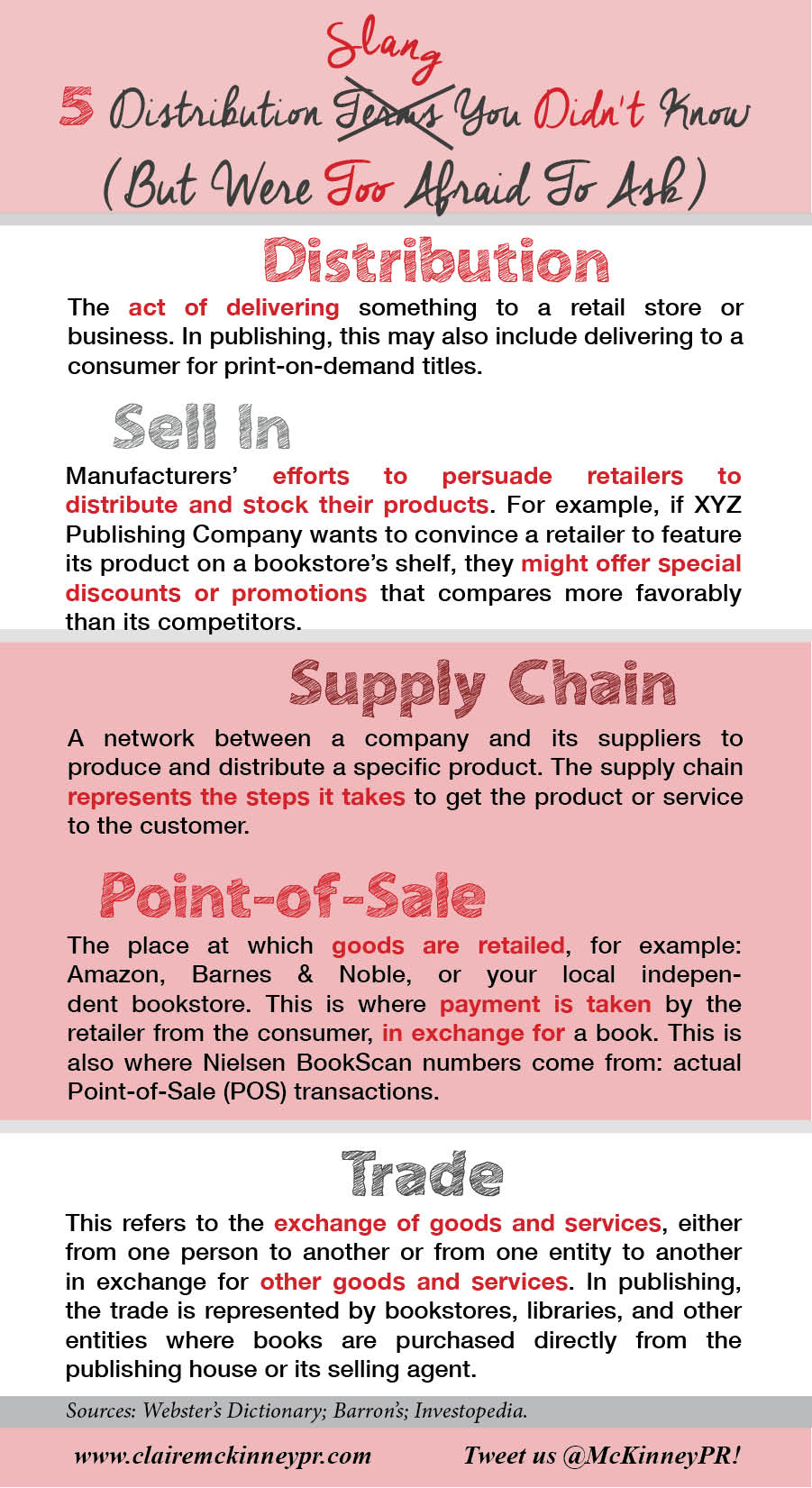
Distribution Slang You Didn’t Know (But Were Too Afraid to Ask)

Distribution. Point-of-Sale. Sell in. These are all examples of distribution slang that is used in publishing. But what do these words mean? If you are an author, here are some key terms to memorize when it comes to distributing your book(s).

5 Distribution Slang You Didn’t Know, But Were Too Afraid to Ask:

distribution slang infographic

Are there other publishing or marketing words that you are curious or unsure of what they mean? Tweet at us and we’ll include it in our next round of publishing, publicity, and marketing vocabulary terms!

Check out our other “slang” infographics:

Book Publishing 101: Why Your Distribution Is Disappointing

distribution warehouseThis is for all of the authors or presses that wonder why their books aren’t appearing in stores; aren’t being sold in e-book form on bn.com but are on Amazon; aren’t available for order if a store wants to get copies; and any other question that might arise regarding the overall concern of “why isn’t my book selling?”   The answer is about distribution and sales: just because a book is distributed, doesn’t mean it is actually in a store.

My first job working with adult trade books was at Putnam Publishing, which at the time was the second ranked imprint under Random House in overall sales.  I was a publicist, not a part of the overall management at the publishing house, but I recall a lot of discussion about distribution and problems with it.  In fact the trade press had articles about Random House essentially falling down on the job, unable to get their warehouses to get books to stores in time to meet demand.  Lost sales, angry stores, lost profits–a disaster as far as the industry was concerned.  Today the process is the same in many ways, and vastly different in others.

There are more sales channels options today, than there were several years ago.  Books are sold at stores, online, in digital form, and print-on-demand (POD).  Indie authors may sell books through their own websites via an Amazon virtual warehouse process, while Amazon also sells the books on its site and sends them out through its own warehouse.  Barnes & Noble has distribution centers (DCs) of its own around the country, so the books go from the printer to the publisher’s warehouse to the DC to the individual stores, or directly from the printer to the Barnes & Noble DC…and so on.

Wholesale distributors like Ingram and Baker and Taylor also stock inventory, which is available to stores when needed. Publishers will ship from the printer to any stores directly when orders are placed prior to printing.  All of this falls under the “supply chain” heading, and it’s a topic that comes up routinely at marketing meetings.   Here’s the thing: none of the places where books are sold will have the book on hand unless someone sells it to them.  Traditional houses have a “sales force” and individual reps that handle Amazon and national chains like B&N and Books-A-Million, as well as people who specifically sell to Ingram, Baker and Taylor, Target, Walmart, Sam’s Club, BJ’s, you name it.

Here’s another thing: if you think your book will appear at Barnes & Noble because you have a “distribution” agreement with your publishing agent, house, factory, broker, etc, you are misinformed.  Distribution is about fulfilling an order and in fact it would probably be better if it was explained as such when you sign up to independently publish your book.  Without a dedicated sales team to sell the book “into” stores, it is up to you or your publisher to market to the trade and convince them to dedicate precious shelf space to your title.  Here are a few specifics based on different situations.

If you are publishing on your own, you are either working through a publishing agent like Create Space or you are setting up your own account with Ingram Spark.  Both of these entities include “distribution” in their offerings and they will ship books on demand or when an order is placed.  I believe it’s for a fee, but Ingram will list your book in its catalog with the thousands of others coming out at that time, but that is as far as it goes in terms of letting stores know your book exists.

Online distribution for Amazon/Create Space means that your book will be available on its international sites as well as ours in the U.S.  This feature is included under their Expanded Distribution offering, which is paid for.  For e-books, it does not mean that your book will be available on bn.com or Kobo.  That is something you have to have handled separately.  Ingram does not do any digital distribution and if you use a different self-publisher than Create Space, you will have to see what they offer to make sure you are getting what you want..

If you are being published by a small, independent press, the rules are very similar except that the press will set up the Ingram agreements, handle the paperwork, and take a cut of the profits of course.  Another thing to note is Ingram will not list any indie book until it is basically submitted for printing, which is about 3 weeks ahead of a “pub date”.  So if you do go to your local store to ask them to stock the book, they won’t be able to order it until that time.

If you are published by an independent publisher that has an agreement with one of the big houses to distribute the books or a deal with a company like IPG or NBN, there will be sales people representing your book in the field.  Just keep in mind that they have hundreds of other titles on their lists as well, so it is up to you, your marketing person, or publishing consultant to present the case that your work needs to get front and center attention–a whole ‘nother story I’ll deal with later.

As I write this I see how many arms and legs all of these processes have and how individual results will vary.  It’s a lot like publishing in general–very hard to figure out and difficult to predict.  I am not saying that a book won’t succeed because of all of the above.  As with everything I write here, this is information to keep in mind as you are going through the process, so you can make decisions and ask the right questions without feeling like you are in the dark.