
Social Media 101: 4 Reasons Why Buying Followers is a Bad Idea

buying followers
This office dog is confused and upset about why he is seeing so many disturbing spam followers on a Twitter account that is supposed to be family friendly!

A recent article (February 1st) on BuzzFeed said that the Newsweek Media Group has been buying followers and manipulating traffic on some of their websites, and that they are being accused of ad fraud.  The ad fraud part of this story is not my area, but I do have something to say about the other part—buying followers—as it relates to marketing and branding using social media platforms.

There was a time when having 200,000 Twitter followers looked impressive to the naked eye, but those days are long gone.  Now it isn’t very difficult to look through someone’s following on various platforms to find out that many of those 200,000 are spam bots and other kinds of cheap “friends”.  In fact, the people who have more modest numbers of active followers, who engage with them, and build more solid relationships over time, could have the upper hand in social media marketing.

Here are some reasons why buying followers is a bad idea:

  1. The internet is not an alien universe.  The people using the internet and social media are just that—people.  And the rules of engagement apply just as they would at a cocktail party or a business conference.  If you want to grow as an influencer on social media, your audience needs to feel like you are a real person —not a virtual identity with no substance, which brings me to the next point.
  2. Trust is more important than ever. The internet, the very tool you want to use to market your products and ideas, has eroded trust in its own population.  This is partly due to the “bad apples” in the bunch who have figured out how to buy and sell cotton candy entities and canned content.  If someone takes more than a cursory look at who is following you and they find porn (true story) in the form of bots, it will not make a good impression (unless that is what you are selling).
  3. Relationships rule! When there is trust, the chance for a relationship to grow increases.  In a relationship with good communication, the other person believes what you have to say, appreciates your advice and counsel, and may even talk about you with others in a positive way.
  4. Protect the brand. Would you wear dirty clothes to a job interview?  Why sully your brand with ineffective and questionable marketing practices, like buying a fake community?

Perhaps we think that, because we are typing on a keyboard or a phone in our own private spaces, that our anonymity allows us to behave in any manner we want.  Well, it doesn’t.  Companies who engage in buying followers or traffic in order to beef up their potential advertising power may not be doing something illegal, but it is certainly unethical.  If an individual wants to be an influencer, it needs to be clear that community and engagement are a priority.  If bots are all we see, we assume that you aren’t real either.

Check out our other social media blog posts here.

Social Media 101: What is a hashtag?

Hashtag CMPR

The other night, while delivering a presentation on social media, a familiar question was raised: “Excuse me, but I’m not totally sure what a hashtag is or how to use one?”

What is a hashtag?

I have found that what is most confusing to new social media users is that they are unaware of the dual identity for the common symbol “#”.  On the one hand we know it to be a pound sign, but it also goes by the name hashtag.  So the old, “press the pound key” you hear on voice recordings is the mild mannered version of “#”, whereas the hashtag has grown to be a huge part of online marketing and social media.

What does a hashtag do?

For phone calls, a hash/pound will help you get to a certain voicemail box or person (or robot) to speak with. For social media, it’s a whole different ballgame. On Twitter, Instagram, and Facebook, a hashtag acts as kind of “file cabinet” that contains information related to one idea.

For example, say you write on Twitter, “Ugh. Today at work I dropped the birthday cake for Jane. And then I tripped and landed face first into it. #FAIL.” When I type in FAIL with the # symbol in front of it, it will turn into a blue link that, when clicked, will send you into a Twitter stream where everyone else is posting about fails. By adding a hashtag in a social media post, you are allowing your post to be filtered, curated, and discovered.

How are hashtags used?

Hashtags are used for all sorts of reasons, including: news items, funny moments, branding, ways to relate to others, labels, and much, much more. Here are some examples:

News Items: When Director James Comey was dismissed last week by the White House, many media outlets that are active on Twitter reported on it using the hashtag #ComeyFiring.

Funny: Once in a while somebody will start a hashtag that gets picked up virally and everyone joins in on the fun. For instance, the hashtag #explainafilmplotbadly gets attention now and then, like this one about Star Wars VII: A Force Awakens:

https://twitter.com/ExplainAPlotBad/status/861221079485882368

Branding: If you have a company and want to start a brand campaign, you’ll want a single hashtag that you can use over again. When Coca-Cola started making Coke labels with names on them, their hashtag for the campaign was #ShareaCoke.

Labels: On Instagram, it is becoming increasingly popular for people to create a cutesy hashtag for their weddings; and make sure that guests who post pictures also use that hashtag. For my wedding, we will be using the hashtag #WinterbottomsUp as a play on Winterbottom and “bottoms up”. Hopefully everyone who posts on Instagram at my wedding will label pictures with that hashtag so that when we click on it, Instagram will filter and we will be able to see all the photos people posted at our wedding. You can do this on Twitter too. Are you planning to run in a marathon and want to chronicle your journey from running 1 mile a day to 26? Create a hashtag that is unique to you, so that you can click on it and search through those specific posts (such as #LucysRunningJourney or #TomsMajorMarathon).

Relating To Others: Are you a writer struggling to make it big? #WritersLife is used by other writers and authors. If you’re a college student, #collegelife might be one you can relate to. Other examples are hashtags like #FridayReads where you can join thousands of people discussing what they are reading this weekend. This NPR post below included both #FridayReads and a Free Comic Book Day hashtag:

What else is out there?

Some other good hashtags on Twitter, Instagram, and Facebook that are popular with writers and readers include: #FridayReads, #amwriting, #amreading, #writerslife, #authorlife, #bookstagram (Instagram specific), #authorsoninstagram, #writersoninstagram, #bookshelfie (taking a photo of a current book you are reading on your shelf).

Twitter, Facebook, or any social media outlet can be daunting when you’ve never really been a social media fanatic. But the best way to practice using these hashtags and to begin to cull an audience is to just start doing it! Don’t be afraid of putting yourself out there. If you really aren’t sure of where to start, even just tweeting about a book you are reading or a movie you watched the night before (with the hashtags #book #StephenKing #DarkTower or #movie #GuardiansoftheGalaxy) will help you test the waters of social media!

For more information on social media terms, check out our introduction post.

Social Media 101: Pinterest Infographic

Facebook, Twitter, and Instagram are the three most popular social media platforms out there. We’re so focused on these three that we forget there are other great, useful platforms out there – like Pinterest. Pinterest is a colorful, fun tool that you can use to promote your book or brand. This week, we have a Pinterest infographic that will help you start an account. Read a more detailed blog post on using Pinterest as an author tool here.

If you are interested in more social media platforms and how to use them, download our free social media 101 guide.

Our Pinterest Infographic:

pinterest infographic cmpr

Social Media 101: Twitter Infographic

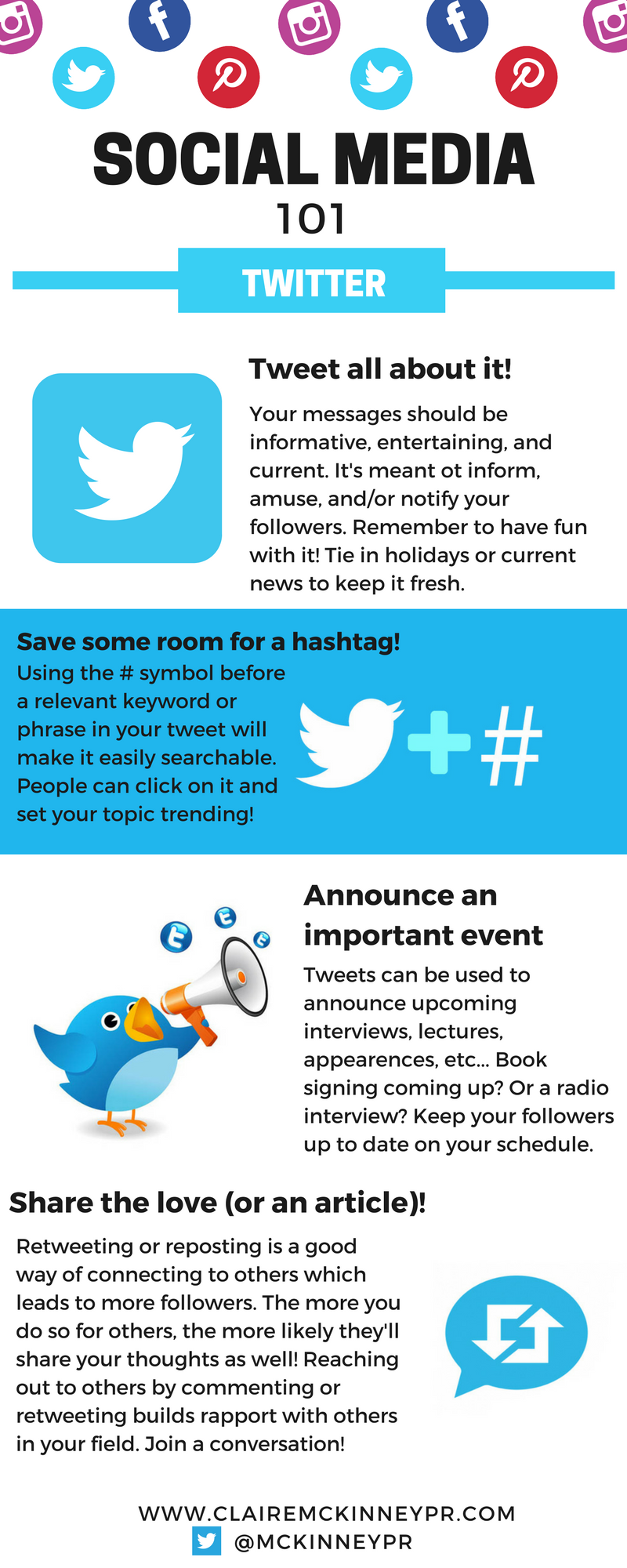
Twitter: the online platform that authors, when asking us about social media, always seem to be the most hesitant about. While Twitter can be daunting at first, it’s actually quite useful and fun. There’s a huge audience of book lovers that use Twitter, from book bloggers to critics to consumers. With our Twitter infographic you’ll get some tips on how to reach some of these people.

This week, we have an infographic that will help you start a Twitter handle. Read a more detailed blog post on using Twitter as an author tool here.

If you are interested in more social media platforms and how to use them, download our free social media 101 guide.

Our Twitter Infographic:

Twitter Infographic

Social Media 101: Social Media Terms – An Introduction

As brands big and small have discovered, social media is its own animal, especially when it comes to building an online presence. If you are just starting out on social media, or plan to start soon, we have some important social media terms you should know to help you understand how to create an online brand presence and use it to your best potential.

Handle: A word that is only for usernames that use the at (@) symbol. Twitter and Instagram are the two most popular platforms that use them. For instance, our Twitter handle is @mckinneypr, and it is implied that you know to go to twitter.com/@mckinneypr to find us.

Facebook Page: Do you have a Facebook account and wonder what people mean when people ask if you have a Facebook page? It doesn’t sound different, but it is. A Facebook account is your personal account that all your friends are on, while a Facebook page is for your business or creative endeavor. You have to create a page from your personal account, and you can allow people you trust, such as your teen or social media manager, to manage your Facebook Page from their own Facebook account. Your friends also don’t automatically roll over to your Facebook Page-you have to invite them to like it.

Hashtag: What many social media mavens know as the hashtag, and you may know as the pound sign (#). The “#” is used across almost all social media networks. Each time you hashtag something, it becomes a link that you can click on and view other posts by other people with that hashtag, in that social media network. For instance, if you tweet a photo of yourself with an ice cream cone that fell on the ground, you might caption it with “Ice cream #fail.” Click on #fail and it links you to a bunch of other people who tweeted about their own fails.

For a cuter example, American Kennel Club’s Instagram (@americankennelclub) posted a picture of a border collie with the #BorderCollie, which then went into Instagram’s hashtag category of people posting and tagging photos of their border collies.

social media terms hashtag
American Kennel Club tagged #bordercollie on Instagram for all those border collie lovers out there to enjoy this adorable photo.

Organic/Paid Reach: The different ways that people are engaging with your social media posts. Organic reach is when interaction happens naturally, such as your Facebook followers reading your Facebook post about your bad attempt to make non-bake chocolate chip cookies. Paid reach is when you pay to have the social media network reach out to people that aren’t following your page. If you are an author looking for some Facebook visibility on your new thriller novel, you might target paid outreach to users whose interests include books.

social media terms paid outreach
The box that opens up when you are deciding on paid outreach. You can target people by their interests.

Content: Valuable, free information that you provide on your blog that you may promote on social media. For instance, NerdWallet is a company that offers financial tools. Their blog provides useful info on things people want to know, like rewards credit cards, best interest transfers, and banking news.

Check out our blog for another edition on social media terms and what they mean. And by the way, Internet Trolls are not the same thing as the ones hiding under bridges (but they are similar).